“A happy river on a sunny day.” — #3

Dear #3 — Indeed. Many thanks.

“A happy river on a sunny day.” — #3
Dear #3 — Indeed. Many thanks.
I would love to hear your thoughts on “my” river. A river that meets the ocean. She has more than one obstacle to push through before flowing into the sublime. – Fluid Chaos

Dear Delight-filled Fluid Chaos –
What a lovely sight you are. And remarkable:
“Nothing in the world is as soft and yielding as water. Yet for dissolving the hard and inflexible, nothing can surpass it.” — Lao Tzu, Tao Te Ching, Chapter 78, translated by Stephen Mitchell
Like you, researchers in mathematics and physics find that chaos actually can lead to higher levels of order. Science writer Robert Pool paints my favorite image — chaos is order disguised as disorder, a sheep in wolf’s clothing.
Your eloquent name for yourself and your river tells me you know this. How over and over in life, catalytic events throw us into turmoil. And how this disorientation can be our most direct line to wonder. Letting that confusion be okay – that’s what allows us to surface from disorder into a resplendent higher order.
I love you, Fluid Chaos.
“Read my river, please! Though I wouldn’t know which one to submit…” –T
Dearest T,
I love that you have many rivers! Your descriptions of them are leading me on fascinating explorations. And all the while I keep chanting under my breath “many rivers.”
I just figured out why this tickles. Many Rivers is what Irish-English poet David Whyte named his company. In today’s next delightful synchronicity, his most recent collection, River Flow (Many Rivers Press, 2007) includes “The Seven Streams”:
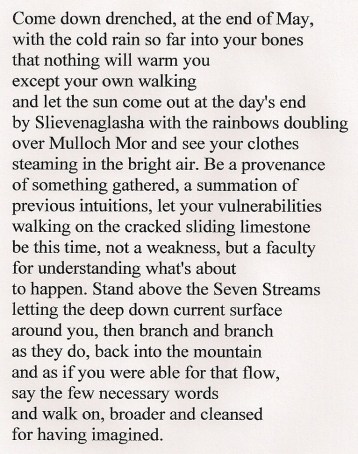
Perhaps you branch and branch like they do… like lawyer turned mediator; spiritual seeker; beloved source of light and sustenance as daughter, sister, friend, wife; painter; poet and writer; yoga teacher; and most miraculously, #7: mother to a toddler and a babe. For…
“… in the northern part of the Parish of Kilnaboy is a townland called Teeskagh and near it a mountain called Slieve na Glaisé, the mountain of the celebrated cow called Glas Ghoibhneach, said to have belonged to the smith, Lon Mac Loimhtha, the first that ever made edged weapons in Ireland. He lived in a cave in this mountain unknown to all the Scoti except the few who lived in his immediate vicinity. He had lived a long time in Ireland before his art was in requisition, for before his time the Irish used no iron or steel implements of war, but fought with sticks having stone, flint and bronze heads. Lon was for many years supported by his invaluable cow called Glas Gaibhneach which used to graze not far from his forge on the mountain of Sliabh na Glaise which abounds in most beautiful rills and luxuriant pasturage. He had found no other retired spot in Ireland sufficiently fertile to feed the Glas but this. This cow would fill with her milk any vessel, be it never so large, into which she was milked, and it became a saying in the neighbourhood that no vessel could be found which the Glas would not fill at one milking. At last two women laid a wager on this point, one insisting that no vessel, be it never so large, could be found in Ireland which the smith’s cow would not fill, and the other that there could. The bets being placed in secure hands, the latter lady went to her barn and took out a sieve which she took to Slieve na Glaise, and into which, by consent of Lon Mac Liomhtha, she milked the cow. And behold! the milk, passing through the bottom of the sieve and even overflowing it, fell to the ground and divided into seven rivulets called Seacht Srotha na t-Aéscaíghe, the Seven Streams of the overflowing. Taescach, i.e., the overflowing, is now the name of a Townland lying to the west of Slieve na Glaise. Clear streams of water now run through the channels then formed by the copious floods of the milk of the Glas.”
— Excerpted from an 1839 collection in the Clare County Library
Your vulnerabilities walking on the cracked sliding limestone, those very openings sieve the charmed rivulets into flowing…
back into the one mountain with pasturage luxuriant enough to feed she who supports so many.
I suspect you share this secret of the ancient Overflowing — a rock mountain you dip back into, faulted, abundant, and nourishing.
Happy Birthday, Beloved Taescach.

“My greatest fear is of stagnation, which encourages me to flow quickly and unceasingly. I need to slow down some — any recommendations dear rivers?” — H
Dearest H — This year a neighboring town retained me TO INVESTIGATE YOUR FIRST SENTENCE. I am not kidding!. The Town Council wanted “to improve the stagnant abandoned side channels of Tongue River” in the untamed section of their diverse park which also includes the active river channel, a skateboard park, horseshoe pits, gazebo, and soccer fields.
May:
The season is early, yet already you can see the  water surface growing various greenish mats; other slimy plants rising from below to clog the water; and the bottom deep in oily goo. You’ll have to imagine the tangy aroma and buzzing mosquitoes.
What follows is my attempt to convey the tone and content of several hours spent with Tongue Oxbow – communication was less verbal than with other water bodies. And very deliberate. I couldn’t always differentiate my thoughts from the water’s. I felt them being identified, questioned at the most basic level.
~
Stagnation is something to fear. Oh? Well. Well, there’s no movement. {Energy flows here… in a different way… nourishing.} So stillness is scary? It’s the stink. And it’s messy. Stink? It’s the decay. This place reeks of death, not life.
~
October:
A grief-stricken, terrified woman in physical pain is dissembling in front of us. One person rises, moves to stand behind the woman, places her hands on the woman’s shoulders. That’s all. The woman draws a few shuddering breaths, then she sighs. She isn’t transported out of what’s happening, in fact she is more able to deal with it.
What would have happened if that person had skipped lightly over and started chatting the woman up? A certain environment distills such a person:
January — “I have thoughts triggered by the question, “Are you living or dying?” I have pondered it while walking. Having been … supporting patients and their families since 1993, I have witnessed much suffering (most of it clean pain, to use Martha Beck’s term) and the dying process up close. I have had an epiphany in the last 5 days… Just as love is not the opposite of hate (indifference is the opposite of both), death is not the opposite of life. Death is a part of life.”
~
Is not death teeming with life?
~
January, Town Council meeting:
I describe the insect, amphibian, bird, and mammal sign in their wetlands; the narrow, low paths and forts created by kids in a wild place so close to home. I recommend only that they buy bat houses to cut down on mosquitoes. They seem relieved.
Looking again at Tongue Oxbow’s so-called stagnant channel, it feels serene and almost shocking fertile – a respite from the quick and so-called civilized. Like that caregiver. Your gifts are palpable, dear H.
With love and admiration,
Betsy
PS — Messy? Oh yeah. Count on it.
PPS — A second stream wanted this post. She explains that you already understand the value of slowing down and merely asked HOW. Wetlands are not the only leisurely water. Indeed, she IS just the one to tell you about another great option — I’ll transcribe her comments… after I relish a nourishing bit of stagnant percolation.
I just received this response to yesterday’s post about Paradise. A photo was attached!
 “Dear Betsy… I’m sitting here at my computer getting ready to start the day and laughed out loud when I realized the significance of the image I’ve had as the wallpaper on my desktop for the last couple of weeks … check it out!” Peanut
River candy for Valentine’s Day– let’s read Peanut’s river as if it were her palm.
I see:
I don’t see:
Dearest Peanut,
I have a hunch you’re plunging through massive change in a short time. TWO big changes, to be exact. Plus a side endeavor that’s not as intense. Although the end result of these changes is not yet known to you, the entire scenario (including the other living things around you) feels to you like Paradise. Why? Because your very movement through life is underlain and surrounded by the strongest stuff available – freedom. Freedom of mind. Tell me where I’m wrong 🙂
PS – Your note came in as I was working on two other reader’s questions. One concerns splitting life between multiple enterprises. The other involves operating in an ultra straight-forward fashion. Coincidentally (??) they each relate to your river too. “We are all connected to each other!” With goose bumps and XX – B
PPS – Happy Valentine’s Day, Peanut. (I just love to say “Peanut!”)
Welcome to the Dear Abby of rivers — an intermittent advice column in which real streams tell you, from experience, how to thrive WITH your own original immoderations.
Our first correspondent dives right in:
love love love this! i hope i’ve managed to get myself positioned as your very first commenter – perhaps that’s one of my little excesses (you and the rivers can ponder how this translates) J
i, of course, adore your use of the word ponder and can’t wait to read more of the river’s meanderings. xoxo
— KC
With that, she was off to something new and exciting! KC, you sure are first, and I’m so glad — you spurred me to get in touch with a spirited individual who (not so coincidentally) lives near you:Paradise is a gorgeous cascading river who shares your taste for jumping in first. When I approach her with an idea, she answers “oh yeah” and is improvising an extravagant, fruitful adventure before I finish my sentence. Paradise thrives on a sense of urgency. Her way of moving through the world is to take a quick leap then pause for a deeper, more reflective interlude. Leap, ponder, step, pool… indeed, hydrologists characterize Paradise as a step-pool channel.
Paradise’s reply to your letter was…swift:
Hey KC — do it in huge boulders!!
XXX Paradise
ps — bedrock is a rush too — those pools are so clear 🙂
Paradise is right. A “quick-start” stream’s welfare depends on its bed material. This kind of channel is stable only when made of, living in, running through, and working with big solid rock. The usual things that threaten a river — damaged vegetation, altered flows, slope changes, eroding banks — don’t faze a stream based in boulders or bedrock.
If we want to live like Paradise, we must ask ourselves, “What is it that I am made of, live in, run through, and work with? What is my foundation?”
~
Of course a human being’s foundation is never some external circumstance. Our base is what we think and believe about circumstances — because those thoughts determine our emotions, which govern our actions, which have consequences. Those consequences always support the original thought that flavored the entire domino effect (Brooke Castillo describes this so nicely in her book Self Coaching 101).
Is our strongest foundation one of hard, immobile beliefs? Will those keep us safe?
“If you don’t get what you want, you suffer; if you get what you don’t want, you suffer; even when you get exactly what you want, you still suffer because you can’t hold on to it forever. Your mind is your predicament. It wants to be free of change. Free of pain, free of the obligations of life and death. But change is law and no amount of pretending will alter that reality.”
A free mind embraces the reality of change. Minds as free as KC, Paradise, and Socrates actually INITIATE change — in joy.
No matter OUR present circumstances or fears, any of us can cultivate a free mind. We can influence our thoughts — wiggling them, questioning (hence “Socratic Method!”). Sometimes a thought will move a bit. Sometimes a rigid identity will fall away.

“It is in dying that we are born to eternal life.”
— Saint Francis of Assisi
My favorite technique for playing with this light, open sensation is available on Byron Katie’s website. Another resource is Acceptance and Commitment Therapy (ACT) co-founder and pioneer in cognitive resarch Dr. Steven Hayes of the University of Nevada, Reno [Wolf Pack — holla! ].
And thanks, KC, for helping us glimpse the real nature of Paradise – the quick steps and pondering pools of a clear mind.
One opinion:
“Moderation is commonly firm, and firmness is commonly successful.”
— Samuel Johnson
I like to imagine Dr. Johnson walking along the banks of a classic rapid-dominated river, letting it shape his life view — for that beautifully moderate river type is also the most stable of streams. It’s not easily degraded by rainstorms, drought, land development, or other environmental shifts. Take a look and see if you can pick out the defining characteristics of this resilient river. Each such trait hands us a profound metaphorical tip worth pondering:
- The edges incline gradually like an open-mouthed “U.”
- The water moves along nicely, yet it’s no raging torrent.
- During spring runoff, the water surface will get a bit wider but not spread out as far as most rivers. This kind of stream keeps extra flow right within its channel — just getting deeper — much more often than most streams.
- From a bird’s-eye view, the stream pattern has some curve to it though you wouldn’t call it “meandering.”
And here is a picture of Dr. Johnson that you can also study: As an advertisement for moderation, he may inadvertently promote..
Another opinion:
“Moderation is a virtue only in those who are thought to have an alternative.”
Aha! Haven’t we always suspected there’s more going on behind those intellectual glasses, just based on Nancy alone?
So what’s a stream to do?
Naturally, you don’t want to destabilize when confronted with life’s changes .. but is moderation the only strategy for success? Often your favorite immoderation really brings you alive. Indeed, it’s part of your original medicine, your unique mix of gifts and talents that only you can bring to this world.
Never fear. Some pretty fantastic rivers are famously immoderate and they have agreed to advise you. Send me an email or comment describing YOUR trademark excess. I’ll forward your letters to my favorite healthy-and-wild streams, then post their responses: real-world perspectives on how you can live the life resilient plus enhance everyone’s journey with your own delightful alternative to moderation.
(I won’t use your real name on the site. The rivers will demand it of course, but they know how to keep a secret.)
This site is being designed in keeping with natural principles, materials, and joy. Check back soon!

 Like a River...