Author Archives: Betsy Pearson

… grieving

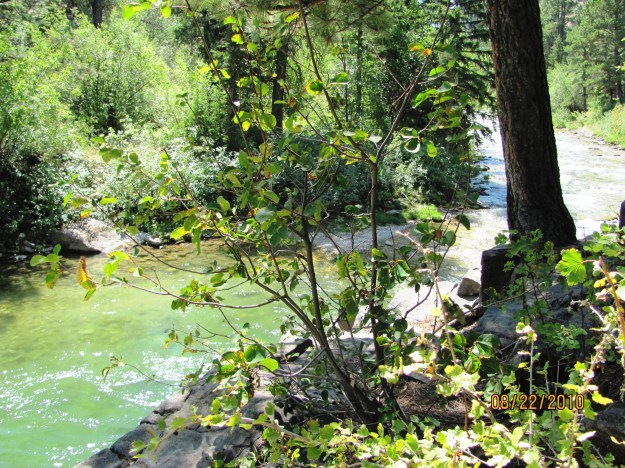
Do you remember Peanut? I just learned she was killed in a car crash by a speeding driver who ran a red light in Phoenix 11 days ago. She was as inspiring and lovely as the photo she sent me of herself as a river:

Sherri ended her emails with quotes that she changed pretty often. Here are her most recent:

Think about your highest purpose in 2011. Set up your calendar to that end, and everything will run better. — Martha Beck

I believe that every person is born with talent. — Maya Angelou

I think one of the reasons I’m popular again is because I’m wearing a tie. You have to be different! — Tony Bennett

The most fun is getting paid to learn things. —  Diane Sawyer

And her final one was:

Nobody cares if you can’t dance. Just get up and dance. — Dave Berry

I am very sad for the world’s loss — I will miss Sherri May. Please join me in sending love and healing to her family and to the driver that killed her.

… you have a reference reach (probably many)

“A river body reveals the river’s present health, its trend, AND its highest potential.”

                                                                        — Like A River Credo

When designing a stream restoration, I aim for the stream’s best natural state. And the stream itself — its geomorphic character — shows me that ideal.

BUT wait… if it needs repair, then that stream’s destablized. How can I possibly learn about health from an unhappy river body?

I find a reference reach.

It always seems like a miracle

No matter what untoward events have occurred in a stream’s life, one healthy fragment remains SOMEWHERE. Usually there are several. Each lovely piece, no matter how tiny, provides a hint about that stream’s true nature.

Like a river, YOUR experience of life contains clues — incredibly specific messages as to the nature of your true calling and how to fulfill it. I guarantee it.

Identifying a personal reference reach

First, let’s set up your own stream-of-life-meter (aka Body Compass in Martha Beck‘s writing) to read your “earthen body.” Imagine a linear scale running from -10 to +10.

At one extreme, -10 represents your human equivalent of feeling like a gutted river with raw banks, piles of goop in the middle of the channel, abrupt drop-offs, and flotsam-laden scour holes.

On the other end, a +10 is when you feel like an idyllic stream in perfect health, full of life.
To calibrate your stream-of-life-meter:

1. Remember a fairly bad memory, something on the order of a -8 (no need to revisit total despair!). Close your eyes, relive the bad time, AND notice exactly what you feel in your body. I don’t mean emotions like sadness, fear, or anger, but rather sensations such as tightness, heaviness, heat/cold, numbness, pain, or perhaps, like a river… eroding and clogging. Where in your body do you feel what?

I want you to be able to remember this state without having to relive it, so assign this cluster of sensations a nickname like “ick” or “the burning weight” or whatever captures the fundamental tone.

2. Open your eyes, stand up for a minute, and let that ickiness go. Shake both hands, arms, legs. Take a deep breath in and release the unpleasantness as you exhale.

3. Now remember a wonderful time. A full on +10. It could be a brief second or a whole era. If you find it hard to recall a good memory right after a bad one, no problem — pretend you are breathing perfectly fresh air under a sunny, blue sky. Note each body sensation. As before, name this sensory experience something like “ahh…” or “lightness” so you have a personal shorthand for feeling the joy of a burbling stream.

 Once your stream-of-life-meter is ready, give it something to measure: your life!

1. Write out your schedule for the next day or two.

2. Imagine you are doing the first item on your list — pretend you are right in the middle of it — and notice your body. Is it closer to your icky guttered-channel state or your joyful burbling-stream state? Rate it on your scale (somewhere from -10 to +10). It’s not like you have to change anything overnight based on the results, so try not to judge or modify your reading. It’s just super interesting to discover what actually happens. Be lightly curious.

3. Repeat for each task on your list.

All activities that score higher than a neutral “0” give you hints about your calling. This is how your essential self wants you to live.

Anything you rated as high as +8, 9, or 10 is a reference reach, no matter how small. Later I’ll show you exactly how I use reference reach details as a stream/life design blueprint. For now, delve into what you like about those moments – AND DO MORE OF IT!

If your list has only negatives, don’t despair at all. The important thing is that you’ve activated and EXPERIENCED your stream-of-life-meter. Once tuned into your body’s incorruptible wisdom, there’s no turning back from a life more authentically YOU.

… fluvially geomorphic

Dear LAR,

Our property has what seems like a healthy stream (as far as I can tell). Assuming it is okay, how can we keep it healthy?

— A Neighbor

PS — Will these strategies work for me too??

Hey Neighbor!

Sustaining an already-stable river is simple: let it be itself. All you have to do is NOT force it to be otherwise:

True mastery can be gained

by letting things go their own way.

It can’t be gained by interfering.

— Lao Tzu, Tao Te Ching #48, translated by Stephen Mitchell

People are part of The Way too

And you, my dear neighbor, can trust YOUR inner river.

Your deep, essential self longs to play out your own glorious “way.” In The Soul’s Code, archetypal psychologist James Hillman compares individual soul energy to an acorn that carries the pattern for an oak tree. He believes our unique possibilities are inside of us, ready to manifest in our calling.

We can discover our true calling by noticing anything and everything that, well… CALLS to us. What can’t YOU stay away from, neighbor?

Sometimes it’s just that easy. Alas…

… if you are like me, sometimes it feels impossible to receive any incoming “call.” Usually this is a sign that the outwardly-directed part of you – what Jungians call the persona — deems your calling unworthy. Although absolutely VITAL for negotiating the outer world in service of your essential self, the persona is not good at determining your path. Left unguided, the persona (terribly competently, mind you!) follows expediency and the expectations of others. Your essential self falls out of balance.

A river body never lies

Like a person… a river can become unbalanced by outside influence. You can tell it’s not healthy because the river’s geomorphic character – literally its “earthen body” — suffers. Stream banks may fall into the channel or mid-channel bars may split the stream’s flow.

On the other end of the scale, in its naturally balanced state, the river’s whole body — its banks, bed, and adjacent floodplain – is stable and full of life.

The branch of hydrology that I love acquired its very name, Fluvial Geomorphology, because we wade right into the river and slosh all over the place to learn what we need to know: we study the earthen bodies (geo +morph) created by flowing water (fluvial). THE principle underpinning my stream work is this: 

The river body itself shows us everything we need in order to understand the river’s health, its trend, AND its highest potential.

How cool is that.

Like a river… your body is an “Essential-Self Detector”

I’m finding that the Fluvial Geomorphology paradigm applies to my life as well as it does to the rivers. It will work for you too, neighbor. To hear your essential self’s call, simply study your own earthen body — from the inside.

Next time we’ll learn EXACTLY HOW you can wade back in to yourself. Happy preview:

Feel free to go outside right now and practice! See you in the creek, neighbor.

… surviving your inner spring runoff.

It seems fast flows are muddying streams across the land – and so many of our personal lives as well. And that’s okay. Periodic peak flows are to be expected on any river. They are in fact essential for the river’s well-being.

While the same may be said for our psyches, it is also true that a fragile river — inner OR outer — may begin to unravel during floods. Here are 4 tips for ensuring that you benefit from your personal flood without destabilizing:

River Runoff Recommendations

1. Utilize a huge floodplain. Allow lots of extra space and helpers (plants, animals, spiritual practices… hey, even people!) to help you spread out, slow down, and absorb excess, murky energy. Click here to see Sassy’s stunning example.

2. Alternately, you can be more independent and self-sufficient, as long as you have a rock solid foundation — and by that I mean you are accustomed to freeing your mind on a regular basis. Of course you can still reconnect with a lush floodplain full of other living things a bit further downstream. Click here to see how the Big Horn makes just such a transition in fewer miles than I drive when I cross it to get to the airport (and back… on those days when I miss the actual airplane)

3. When you feel not only clouded with fine sediment but also as if your foundation, your boundaries, indeed your very world is made of shifting sands, that’s also completely okay. Just  remember that when a stream is dealing with the small stuff, it MUST have luxuriant barbed-wire boundaries. Click here for more information – but only if you’re not too scared of cows.

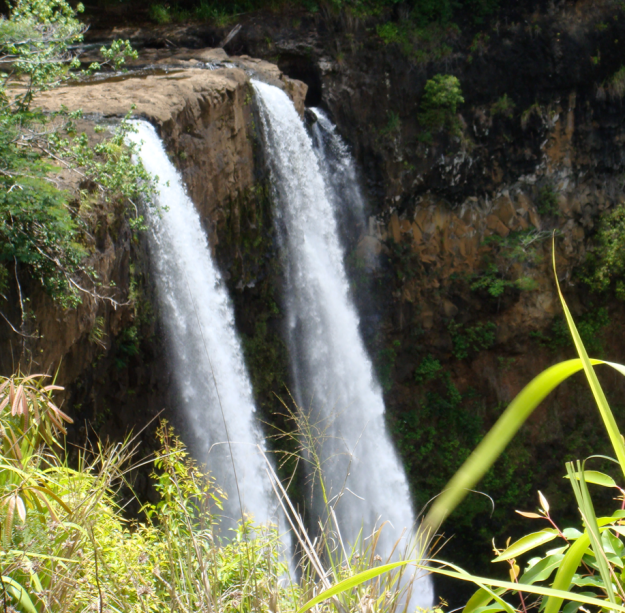
4. If you run into truly extreme turbulence – a personal waterfall episode – then yipee! When a stream gets going super fast, it can change the actual physical “phase” or “state” of water – creating little bubbles of vapor (spirit) right inside the work-a-day liquid (psyche). Click here to learn how the rock-solid Niagara River uses this process to stay dynamic.

You see, even the most stable river is not static. It will shift — in a way that still allows the river to accomplish its life’s work and maintain its own particular character, albeit in a slightly different place and with the extra nourishment that can be provided only by the spring inundation. Rest assured that this is The Way of things, and that our own psychic floods and shifts are just as rewarding.

“The supreme good is like water,

which nourishes all things without trying to.”

Lao Tzu, Tao Te Ching #8, translated by Stephen Mitchell

… muddied

A favorite teacher writes:

Lately, life “seems to be flowing very rapidly and creating turbulence. In my case, colleagues, clients, and friends have been living through experiences that pick up the goblet of my psyche and give it a good shake. The mud that had settled has gotten stirred up again. My theory is that by creating this disturbance, I can strain out more of the mud and create a clearer and clearer mind.”

And if our psyches are as much river as they are goblet, then muddied turbulence is especially essential.

A river’s life work is to carry sediment (“mud”) with its water (psyche/soul).

The faster the water, the more muck it can carry.

When the livin’ is easy…

Even in the calmest season, a classic river alternates fast, shallow, sediment-moving riffles with slow, deep pools where all kinds of stuff settles out. The river CANNOT be one long, clear pool. It would not function. It would not be a river.

And when it’s chaos…

The rhythms of stream life seem especially pertinent this month — to my teacher, her friends, me, my friends, PLUS the real-world rivers. During spring runoff, THE ENTIRE RIVER is moving fast and carrying sediment. Turbulently.

Peak flow

Typically, a stream’s annual “peak flow” matches bankfull in two out of every three years. “Bankfull flow” is the channel-forming flow. The river accomplishes the bulk of its work — during this one period.

Think of what you’re accomplishing during YOUR psychic runoff!

Sometimes the turbulent season hurts bystanders

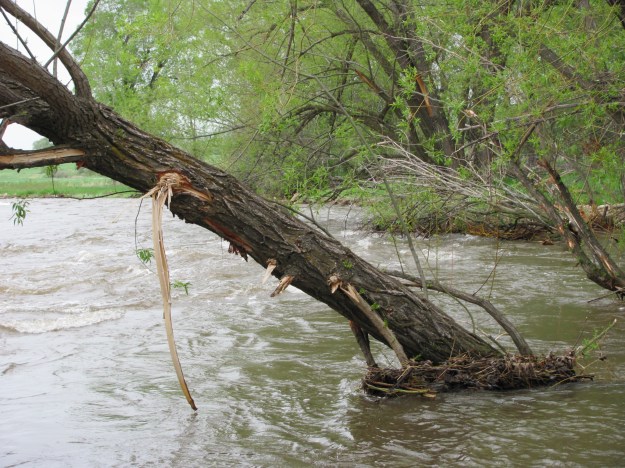
Peak flow is always impressive.

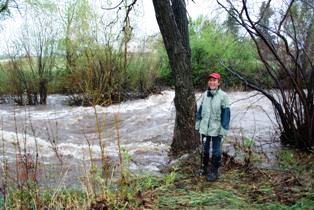
And dangerous for outsiders IF they interact with the stream in the wrong way. Standing next to a swollen river is thrilling; swimming there would hurt.

Warn your loved ones not to swan dive into your psyche just now!

Building a permanent man-made structure in a stream’s floodplain is an even worse idea because about every three or four years, peak flow SHOULD exceed bankfull and flood the adjacent lands. Organic structures, like trees, weather runoff perfectly.

I leave YOU to decide which parts of your life feel like trees and which feel more like artificial constructs.

Because of the risks, humans try super hard to control rivers’ normal flooding — like with a dam that collects peak flow and releases the water gradually. Or levies that laterally confine flood flow in a skinny, deep canal.

The consequences of trying to avoid chaos

The river suffers.

  • Dammed rivers clog with silt because the channel never gets “flushed.”

The resulting deposition not only increases bank stress BUT ALSO suffocates fish eggs right in their redds (best fishery word ever — here‘s a nice diagram).

How many of us have buried our dreams in un-flushed psychic sediment?

  • Confined rivers run so deep and fast that their own artificially increased power requires they cut down into their own foundations.

It’s a desperate feeling.

  • Immediately downstream of both a dam and a confined channel (especially one lined with concrete), a stream does not have enough natural sediment load to match its speed. It’s hungry. It devours its own edges.

We have the energy to carry our life’s work too — we’re built that way! Without our own unique load, we turn our energy in on ourselves.

The living beings that surround the river also need the floods.

  • The most ironical consequence occurs when a dam breaks and kills people with the deluge. There surely were times when I held in my fast flows… and then busted. All over everyone in my path.
  • Most importantly, dams and canals eliminate the adjacent lands’ intermittent inundation with nutrient-and-soil-laden water. The rich riparian ecosystems and traditional croplands starve.

Life around us flourishes in the wake of our messy springs.

… so if it’s all good, then why do we feel uneasy about our chaotic periods? Because we know floods CAN hold dangers for the river itself. For our psyches.

But no worries, dear teacher and friends. Tomorrow we’ll glean tips from all types of streams on EXACTLY how to survive any high flow event.

Until then flood on, beloved muddy ones, flood on!

… who missed the boat.

That’s just plain silly. A river cannot miss a boat. And neither can I.

(Back story: I actually did miss a boat. Well, an airplane. Who does that?? There’s a long explanation in which I am a well-meaning innocent as well as another version in which I am bumbling and humiliated. The following logical points constitute my metaphor-gone-wild attempt to stop wallowing in either.)

Logical Point #1 — The boat isn’t going anywhere without the river.

My trip and all that I was meant to accomplish over the next few days – well, none of that’s going anywhere without me. I can’t miss my own life.

Logical Point #2 — A boat’s purpose is to carry someone across the river without getting wet. But the river doesn’t need to cross itself. And it LIKES getting wet.

If part of the trip was to skate across the surface of my life — ha. I cannot, and I do not want to.

Water is one of a couple dream symbols that Jung felt carried universal meaning — he called it the unconscious. A place where we are connected deeply to soul. Like a river, I enjoy soul inundation. And whadda ya know, here I am. Filled with my life.

Okay I feel a little better…

… thanks for listening. And when the airline sends you a Re-scheduling Notice the day before your trip,  always check the fine print (you know, like the tiny numbers after the word “Date”) to be sure they are not referring to your exact same flight at the exact same time on the exact same day of the week NEXT MONTH! Just sayin.

… already

Dear Like a River,

I hope you will get to writing about renovation soon because I seriously need to get a grip and would love to hear your advice on makeovers, river style!

— Ready for Renovation

My Dear R&R,

You’ve come to the right place. Folks of my professional persuasion have been fixing rivers for a long time. In fact, guess who our federal government deems “responsible for investigating, developing, and maintaining the nation’s water and related environmental resources.”

Yup, engineers, and not just any old engineers — the above quotation is the Google blurb for the ultimate authority over our waterways:  the United States Army Corps of Engineers.

The Department of Defense Against Rivers?

You may wonder why aquatic oversight falls to the army. Partly it’s because navigable rivers have been critical to our country’s political and economic success since our first battles for freedom, and, later, flooding rivers seemed to necessitate defense. But also it’s because our pioneering mindset cast all of nature as a battle-worthy foe.

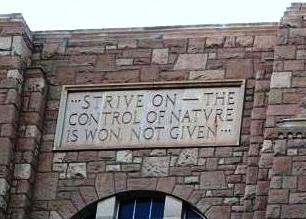
How do I know this? It’s etched in stone on Engineering Hall:

The Control of Nature

Such was the ethic back in the day. Some people still believe it. Some people hate it — until confronted with the flooding of Venice, a tsunami, or the loss of a culturally and economically critical seaport.

In his 1989 book titled…. drum roll…. The Control of Nature, my science/nature writing idol John McPhee chronicles three “places in the world where people have been engaged in all-out battles with nature.” All three battlefields involve water. The frontline is Louisiana, where “the U.S. Army Corps of Engineers has declared war on the lower Mississippi River, which threatens to follow a new route to the sea and cut off New Orleans and Baton Rouge from the rest of the United States.”

What would happen if we didn’t try to stop the Atchafalaya River’s natural progression — if we let it “take all of the Mississippi and become itself the master stream?” New Orleans and Baton Rouge would fail, at least according to one human definition of success.

The Most Dubious Nature of All

Is Nature – i.e., reality — our enemy? Must we fight to control it? Can we ever “win?” I mean, Southern Louisiana seems to be having troubles despite our fierce stall tactics.

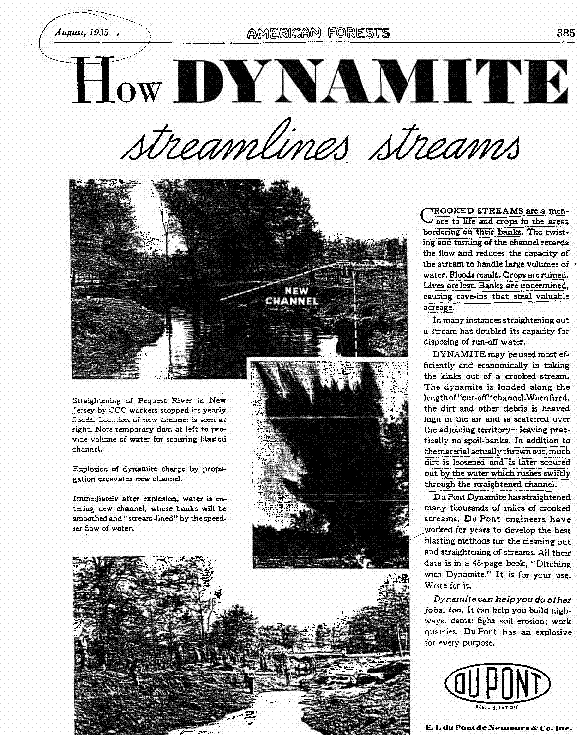
I suspect that you, my honorable friend, have a more objective and empathetic view of the way of the world. I doubt you’d ever deem yourself omniscient enough to dam a river with concrete or straighten a stream with dynamite:

(I have been looking for this old ad for awhile and found it on the rather spunky geomorphology blog for “emriver.” You can go there to view a clearer .pdf file.)

How ridiculous that anyone ever believed a naturally meandering stream to be “a menace to life.”

Yet.

I know that you, RR, like most of us, battle hard to control one particular part of nature – your own unique and human nature. What would happen if we didn’t?

I wonder why you want a makeover. Are you as unhappy with your innate nature as Dupont was with “crooked streams?” I’ve been there. Or are you looking to repair damage, perhaps even damage caused by ill-advised past interventions? I still do that.

But sometimes fixes don’t.

The damage the Control Ethic has wrought on our natural world, especially on rivers, is famous. Just so with our modern fixation on “self-improvement.”

And still…  I LOVE renovating a river.

This time around, hydrologists and engineers are using a new, HOPEFULLY improved, ethic: studying wild streams’ natural tendencies in order to work WITH a damaged river in restoring its health.

I hope we humans can be as kind to ourselves. We’re all basically okay, we’ve all been through some ordeals, and we all can trust our own wholeness as we navigate along.

I applaud your desire to be the best person you can be, dear RR. And I’ll definitely be posting some stimulating parallels in stream restoration – it’s my passion. Until then please know that the primary recommendation for stressed streams echoes your own pen name: R & R! So relax. Rest yourself from overuse AND ESPECIALLY from past “improvements.” And thank you SO MUCH for contributing to this work in progress.

Love to you,

Betsy

… fluent.

“Who holds the river?”

— LG (“Life is Good”)

My friend LG cupped her hands as if carrying water and repeated her question – which did not quite compute, striking me as somehow extremely beautiful and unfounded. Over the next couple days, I kept seeing LG as if through a telescope, forming the question with her hands. Each time, I felt my insides clear into light, easy warmth.

And then I left for the Northwest. My travels happily began with Alaska Airlines’ nationwide computer crash which allowed me plenty of time to soak in the Billings airport’s strangely soulful landscape and pull out my new operating instructions. Without any occasion, LG had given me a present: The Second Half of Life by Angeles Arrien. She said it was my manual now. The book flopped open to page 31 and this poem by John O’Donohue:

The other passengers likely thought I was crying because of the airport coffee (how would they know I love all coffee because it’s, you know, COFFEE) rather than the perfect non-answer to LG’s gorgeously unanswerable question.

And then the java kicked in. I went all left-brain, casting about for the hydrological truth. What REALLY carries the river? Each river is pulled by gravity, but that’s not the same as being “carried.” And each river is housed by this planet, but so is everything else – surely there’s a more uniquely riverine basis for the depth of O’Donohue’s insight.

Things That Could Be Said To Carry A River:

Option 1 – The Water

Technically speaking, stream water carries sedimentlittle pieces of earth.

Option 2 — The Channel

The channel – that specifically-shaped mass of earthen material – carries water.

So the water carries pieces of earth, and the earthen channel carries the water, but…

… wait – what IS The River anyway?

Some would say the water IS the river.

Yet we call an empty stream bed “a river” — albeit a dry river. Perhaps the channel IS the river.

Or maybe the river is both water and channel?

I say no. It’s the interaction between the two. The river is the container plus what the container holds plus the making of that container BY and FROM that which it holds.

The river is a phenomenon — ETERNALLY BUILDING ITSELF with anything and everything that crops up along the way as it moves through time and space.

Surprise

A river’s evolution is a surprise because it totally depends on what happens. It depends on the river’s fine interface with its surroundings — on how much water the river receives and how fast that water comes, on the buried boulders and roots encountered along the way, on the loads washed into the river by storms, on the lay of the land — and on the stream’s own power.

It’s no wonder scientists can’t predict a river’s journey or a human’s destiny, for as O’Donohue describes (in the introduction to Arrien’s book, not so coincidentally):

“… each of us has to inhabit his or her own soul in order to find out who he or she is and where the intimacy of his or her heart touches the world. No one else can tell you that; the maps that others have are of no use. Each life must find its true threshold, that edge where the individual gift fits the outer hunger and where the outer gift fits the inner hunger.

Experience is the arena where this whole adventure happens. The hidden structures of experience become the windows of being. This is how we unfold and enter deeper into knowing.”

This is the astonishing, ongoing realize-ing that carries us… just as fluently as it carries the river.