Category Archives: Uncategorized

… cavitating

Bets, I heard Niagara Falls is head-cutting pretty fast. Really? Through solid rock?

— JJ Mahoney

Yes indeed, Mahoney dear. Historically, Niagara Falls “eroded backwards” almost 4 feet per year. When humans started diverting some of the flow to generate electricity, we reduced the erosion rate to 2 feet per year. This is still impressive considering it’s cutting RIGHT THROUGH ROCK.

Engineers “to the rescue”

Back in the 60’s some folks got worried about the falls’ natural migration. Maybe they had a HUGE HOTEL or HYDROELECTRIC PLANT that wouldn’t do quite so well if their waterfall were nine blocks up the street. The United States Army Corps of Engineers decided to take a peek:

Wowza! The Corps just up and diverted flow to the Canadian side of the river. Engineers dodged tourists to study the dry river bed and determined that cracks in the bed allow water to soak down behind the rock face, building hydrostatic pressure that could push the rock outward and hasten decay.

The Army Corps of Engineers then “repaired” Niagara Falls. Seriously. Workers installed cables, sealed cracks, and/or drilled holes to release pressure, depending on which account you read.

And did it work?

Not really. Even the Army Corps can’t eliminate ordinary erosive forces, and it turns out waterfalls have one EXTRA-ordinary erosive force – cavitation.

The Niagara River flows so quickly over the falls that bubbles form inside the water.

Bubbling water, hmm…

How is that different than boiling water?

It isn’t. Normally, water boils when it’s super hot. (I can identify — when something “makes my blood boil,” I usually feel pretty hot under the collar.)

But Niagara Falls makes cold water boil.

The technical part:

Liquid water turns into water vapor at very specific combinations of pressure and temperature: under lower pressure, water will vaporize at a lower temperature.

For example, at sea level, where the entire earth’s atmosphere weighs on a pot of water, it will boil at 212°F. In Denver, one mile LESS  of atmosphere pushes down on the pot. Water boils there at 202°F. [My Mom says this is why coffee tastes better in San Francisco — she’s pretty AND always thinking!]

When liquid is MOVING… then a whole other variable comes into play: speed.

Free-falling water’s energy has three components: kinetic (from speed), potential (from elevation), and pressure. As the water falls, it loses potential energy, i.e., height above sea level. In a channel, that energy would be transferred into friction work against the bed and banks which is why rivers generally don’t accelerate as they go (unless the total amount of water flowing into the channel changes). But in empty space, the potential energy is transformed into kinetic energy and the water speeds up. Energy can be neither created nor destroyed, so the water’s pressure must decrease to balance the increased kinetic energy.

Depending on temperature, water can drop to its boiling pressure when it reaches a velocity of 40 feet per second.

Upstream of the falls, during regular flows, Niagara River travels at 2-3 feet per second — pretty typical of most streams. During “bankfull” spring runoff, velocities are usually around 5-6 feet per second. Over Niagara Falls, water speeds reach 100 feet per second (68 mph!).

Ouch

The bubbles themselves – officially called “cavities” since if you think about it they ARE actually voids inside the water – don’t hurt anything. But they pop when the water slows, and the collapse emits a shock wave strong enough to etch rock.

Have you ever felt your blood run cold AND roil within your veins? Ack, why do we do this to ourselves? Of course, sometimes, there’s…

Cavitation as a Weapon

Two kinds of shrimps have developed special claws that snap so quickly and precisely as to direct low pressure bubbles onto passing fish. Killing them. I think I dated one of those guys once.

What to make of all this OR… “Potential Life Lessons”

Option 1 — If you go THAT fast, you WILL be powerful in a whole new way. Eventually you’ll experience a sort of internally-caused “suction” that will vaporize your energy until the next time you slow a bit and then, POP, a little shock wave will dissolve whatever it hits. Is this good or bad? It’s just the way the world is. Maybe you can dissolve untrue thoughts or institutions of evil. At times you will erode your own foundation and… horrors, MOVE a little! That’s okay too. No river or human lives a completely static life in one location. Thank goodness.

Option 2 — Definitely avoid external “suctions” that drain your energy! They strike fast, so if you see a smiling pistol shrimp headed your way, run.

Option 3 — Beware the Army Corps of Engineers? Nah — even entire fields of study can evolve, albeit slowly. Please remember that some of your best friends are engineers, and write again soon! XO,

Yohoney

… avulsed (part two)

Dear Daughter of the Vineyard,

Yesterday the Yellowstone River compared her own abrupt shifts to your “spectacular blowout!” I described why and when a river/person chooses such an avulsion, but…

Exactly HOW do they do it??

Let’s start with someone like you or your soul sister, the Yellowstone — someone ready for a path with more energy. When she is hit by a flood and empowered a bit, then:

  • she tops her stream bank boundary,
  • travels overland,
  • finds a shortcut to some future point, and
  • Eureka! She immediately carves out this new channel, right toward her goal.

Hold on though. There’s more, and the divine really IS in this detail.

  • She cuts her new channel “backwards” from her destination. True story.
  • First, the water reaches its target and falls abruptly into that “deeper place” the long-suffering river has been craving. Falling water has a near-vertical slope and therefore TONS of power. Did you experience that rush my friend?
  • Then, the energized water shaves off a bit of soil RIGHT THERE on that sheer face. This actually moves the “drop spot” back a few inches from where it started… so the water cuts more soil from this new location. And so on. In this way, the Yellowstone slices her way through intervening obstacles in an upstream direction. Hydrologists call such backward erosion a head cut.

People who successfully blaze a new way of life do the same thing. They find their ideal end-state FIRST — maybe they see it in someone else’s life or even in a dream — and work back from there.

Easy? Yes and no.

You have FELT a head-cut, my friend. Would you agree with the Yellowstone that it’s temporarily painful and messy to leave the safe course?

Here’s a New England stream immediately after her latest avulsion:

It takes time to re-establish the fine finish of any new path. But as you and the Yellowstone both demonstrate, the final result is vibrant — not only for the river but also for the living things that share her voyage. The quicker new channel provides more rapids with plenty of oxygenation and potential nesting sites for fish. The abandoned oxbow ponds serve as a whole other, necessary ecosystem:

Congratulations on your blowout, dear friend! And many thanks not only for your letter but also for the following, perfectly fitting, reminder:

Security is mostly a superstition. It does not exist in nature, nor do the children of men as a whole experience it. Avoiding danger is no safer in the long run than outright exposure. Life is either a daring adventure, or nothing. – Helen Keller

… for now.

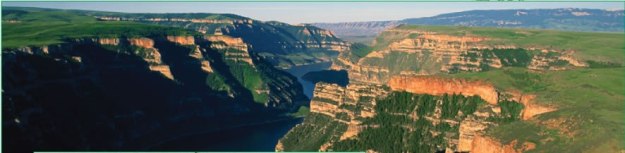
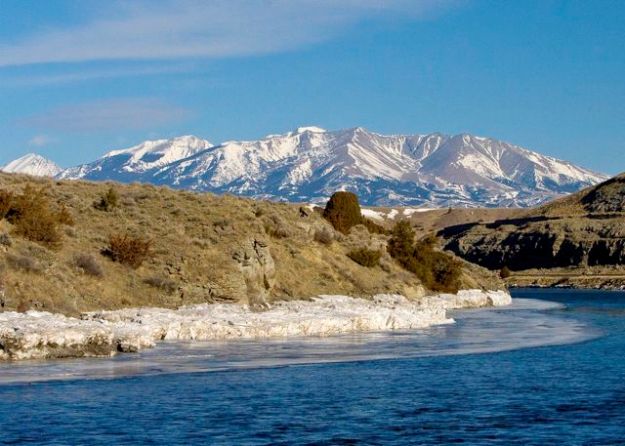
My old homeland of Arizona may have one particularly famous and healthy entrenched reach of the Colorado, but my current territory has the Big Horn. Near the Montana-Wyoming border, the Big Horn River etches its way between the Pryor and Bighorn Mountain Ranges, deep and narrow. Gorge-ous:

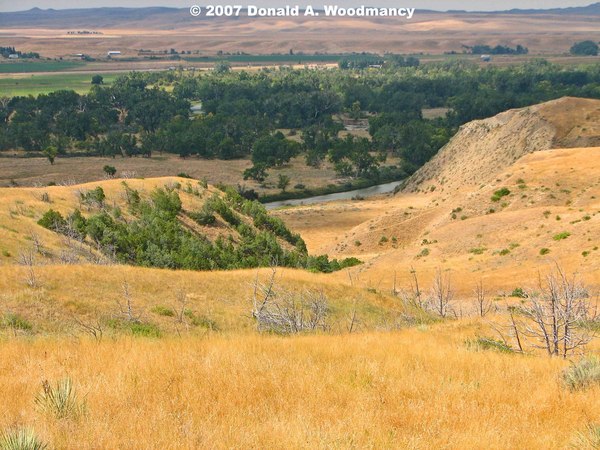
The Big Horn and the Colorado both remind us that a river, like a person, can entrench itself in a mighty way to fit some specific circumstance (like cutting through obstacles, mending itself, or writing a book) AND THEN hook up with its surroundings again later, when the setting’s right. About fifty miles downstream of its canyon, the Big Horn has full connection to a broad floodplain filled with all kinds of kindred souls:

So don’t be afraid to self-isolate when you want to accomplish a monumental task or rest (perhaps the most worthy and monumental doing non-doing of all). Rivers don’t flow in one manner along the course of their journey and neither do you. It’s always and eternally… for now.

… awful

Images of the inexorable mass of water and thick black backwash of suffering left me, like the rest of the world, disoriented. Betrayed. And I became uninterested in rivers, by association. They are water. However the earth’s “solid” mantle brings no guarantee either — its upheaval caused the wave.

I don’t like to fear that which I love. I want a God, a beloved, and a planet I can trust because those connections are sacred.

And yet. Every culture’s understanding of the sacred includes awe – that overwhelming blend of fear and admiration. This remains a mystery to me even as I remember what the river teaches about trust:

• We can trust a river to behave like a river (for example, it will flood about one out of every three years).

• We can trust that we’ll be alright no matter how the river behaves.

Both principles seem impossible to consider right now, except that there are other developments too. Stories of kindness and compassion emanate from Japan itself, even while the crisis continues to unfold. And the rest of the world focuses so much love in one direction.  Awe-full.

PS —  Most sources agree the Red Cross is the best bet philanthropically.  You can use your cell phone to donate $10 to the American Red Cross’ s Japan Earthquake/Tsunami fund. Send a text to the number 90999. Your message should read REDCROSS.  You’ll be charged on your cell bill; alternately, you can donate online at: http://american.redcross.org. Doctor Without Borders gets a lot of recommendations too.

… with luxuriant, barbed-wire boundaries

Dear Like a River,

You know how you say a river running through rock is stable no matter what? Where I live, the rivers run through common, everyday dirt. Please tell me SOME of them are stable! And if so, what are THEIR secrets? Because at this point, MY WHOLE LIFE is basically lots of common, everyday minutiae.

— Queen of the Small Stuff

Dear QSS,

It surely is misleading how rocky waterfalls get so much press time. Like the beloved spots where you’ve waded, boated, and skinny-dipped, most of our planet’s salt-of-the-earth streams have channels of cobble, gravel, sand, or silt.

Similarly, many days (or DECADES) of our human lives are dominated by details. We must see to the particulars to fashion a career. A family. Any creative endeavor.

But never fear, mighty Queen, healthy streams exist in every type of sediment, even the finest of clays. Like them, you can thrive by following this caveat  — tend to your delicate edges:

  • Cultivate densely-and-deeply-rooted surface protection. Hydrologists measure seven variables to calculate a bank’s risk for erosion; three of the seven pertain to vegetation. THE most powerful step in restoring a damaged river doesn’t always involve design calculations or big yellow heavy equipment.  Sometimes it’s planting willows.

What roots you when fast water threatens the margins of your life? Friends? Funny blogs? Leisurely morning runs? Get more of them. Care for them.

  • Maintain your natural shape, especially along the boundaries. Untoward events along a river’s banks cause the stream to widen.  Don’t let the world over-use you. Common culprits include domestic livestock (know some of those?), engineers, and developers often masquerading as sweethearts, family, friends, colleagues, and PTA officers who want to trample, over-graze, widen, channelize, pave, straighten, narrow, confine, or build on your banks. Fence them out. Set the dogs on them if they bust through. Seriously. Losing stream bank integrity, ESPECIALLY in small or variably-sized particles, triggers a series of catastrophic events.

I wish you the best of luck, beloved highness, because in tending the small stuff, you shape our homes, communities, and global innovation just as surely as the streams moving sand toward the sea shape our earth. Some say God is in those details. Others say it’s the Devil.  I agree with William Blake, it’s ALL in every detail:

To see a world in a grain of sand,

And a heaven in a wild flower,

Hold infinity in the palm of your hand,

And eternity in an hour.


… Grand.

I asked about your pet immoderations. About two weeks ago, one of my favorite teachers tweeted:

I love going into seclusion; there’s nothing better in all of life.

She reminds me of one my favorite rivers — THE poster child for what hydrologists term entrenchment.

In-a-trench

Entrenchment describes a river’s relationship to its surrounding landscape. It’s measured by how a river responds to increased flow. When life really starts to rock-and-roll, some rivers spread way out and inundate a huge wide floodplain. But the entrenched river has a high degree of “vertical containment.” She gets deeper and deeper without becoming much wider.

Is this okay?

Popular psychology sometimes worries about secluded individuals. So does hydrology. And yet two types of healthy natural rivers ARE quite thoroughly entrenched. One is the step-pool system I described earlier. The other is perfectly personified by my friend:

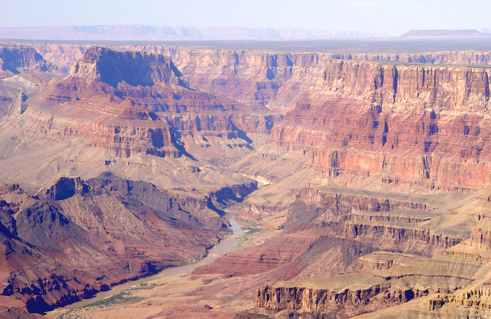
  • considerably entrenched down in some highly weathered material — she’s picturesque both at the close scale and from a panoramic viewpoint;
  • meandering through riffle/pool sequences – boaters love her intermittent respites almost as much as her thrilling rapids; and
  • flowing at low gradient in a relatively wide channel — unlike steep, straight, narrow waterfalls and cascades, my pal’s quite accessible.

People from all over the world invest great effort and money just to be in her presence:

Now that’s a meander.

I told you she was deep. 

So if one of the Seven Natural Wonders is a classic example of entrenchment…

… then why the bad rap?

1. It’s a question of foundation. Again.

An entrenched channel has a trapezoidal shape (unusual in natural streams though a favorite in engineering designs!) AND high stream banks. Physics-wise, this combination directs so much force onto the sidewalls that an entrenched river based on any material smaller than a Volkswagen WILL erode. Typical silt, sand, and gravel rivers simply can’t do well when disconnected from an expansive overflow area.

But the Colorado River (and my teacher) incised herself through layer after layer of solid rock. As we discussed last month, a river with a solid base will always thrive. The same holds true with humans.  Regardless of individual style, when you cultivate a clear, free mind, you’re carving a life in bedrock.

2. What’s left behind

Hydrologists put it like this: “entrenched rivers develop by abandoning their historic floodplains.” What’s left behind is no longer directly nourished by the river. That community (soil, plants, animals) converts to a different ecosystem. Plus now only a flood of huge magnitude makes the entrenched river over-top her banks — she can manage most action on her own. The adjacent flat is no longer indispensable. That’s a lot of change for folks to handle.

3. A reminder

Here’s how The Colorado herself responds to my mentor’s tweet.

Dear Teacher to Many,

Entrenchment reminds us of what trauma does – it makes a river downcut, often steeply and in a hyper-straight fashion. I imagine it’s similar with people. When the down-cutting ceases, the river’s back to her innate slope, albeit at a “deeper level,” and the river begins to broaden herself in order to once again create space for meandering.

This healing stage is a joyfully entrenched one.

No wonder we awe, frighten, and inspire.

Yours — C

And that’s one reason why the Colorado River and Martha Beck are my heroes.

… rich

Dear Betsy — So maybe one of your other rivers could answer my question: at what point am I spreading myself too thin and how do I ensure quality over quantity! – The Strong Gold Heart River


Dear Strong Gold Heart,

What a valuable question. THE single most common river problem occurs when some event widens a stream’s channel, requiring the usual flow to cover more area than usual.  The broadening stream becomes shallower — literally “spread thin!”

Stretching out always forces a river to loose speed — a beautiful thing when it happens on the stream’s floodplain. But when it happens in the main channel, there’s trouble.

A stream’s power (its energy during any given period of time) is directly proportional to velocity. As it slows, the stream can’t do its life’s work — carrying clay, boulders, or whatever sediment is at hand. A human life’s work more likely includes preparing dinner, a joke, an account, a romantic moment, a book, yet another book… how do you know when you’re out of control??

There are two sure-fire ways to recognize a spread-thin river.

1st Red Flag: Aggrading

The stream drops its load. Right there in the middle of its channel.

2nd Red Flag: Degrading

Ironically, after the water lightens itself, it has EXCESS energy:

  • because it’s hungry (so the stream eats its own edges ragged); and
  • because the sediment wedge creates a drop off the backside (making the water more steep and powerful at that spot).
    • This falling water digs pools where there should be shallower riffles, and
    • as it erodes the back of the sediment wedge, the falling water slices its way upstream. Such “head cuts” create whitewater-like riffles even on bends where there should be calm pools.

Here’s my own Big Goose Creek. You can see the sediment wedge turning into a center island, the raw stream bank on the right, and, if you look closely, some misplaced ruffled water characteristic of a head cut:

So in answer to the first part of your question, my friend: If your edges fray, if you develop stagnant piles of stuff where there should be easy flow, or if you’re tackling rapids where there should be serene water, then you are spread too thin.

How to ensure this doesn’t happen? I am preparing some specific stream-type energy management ideas. Meanwhile, I LOVE how human energy is portrayed in this guided meditation as a balanced braid of three “currencies” — physical, financial, and time.

We call someone with robust physical energy healthy, someone with abundant financial energy wealthy… and maybe Ben Franklin alludes to wholesome time energy in the final third of his phrase “Healthy, Wealthy, and Wise.” Because there’s really no synonym for time.  Nor a name for someone who tends the energy of time — unless, as with you dear river, it’s the one with heart.  Thank you for your letter, your precious support, and your priceless example to those of us who follow your adventures with awe.

“The only question is: Does this path have a heart?  If it does, then it is a good path. If it doesn’t, then it is of no use.” – Carlos Castanada

… live aloha!

I’m back from Hawaii but remember — I went to WORK!  My goal was to find wild rivers on whom I could test our hypothesis:

The most playful play IS rest. AND work. So ALL of daily life is… vacation.

Here are my field notes:

Fail?

My vacation reading list is an identically blank page; I spent zero hours on a computer; and since I was travelling with my two stoic male types, there wasn’t even much conversation. The week was weirdly wordless.

Weird because I like words. A lot. Reading them, writing them, scrolling through them in texts and tweets and posts. Talking them! Listening to them!!

Instead I walked. Snorkeled. Slept. Splashed in waves. Slept. Hiked to waterfalls. STOOD in waterfalls. Slept. And, most wonder-fully of all, SURFED ( pix here!).

So, my week ended up mostly play and sleep. BUT physics-wise, you most certainly have noticed I ALSO performed work the whole time — that is, I was always moving something somewhere. For example:

• Paddling, paddling, paddling my board back out to the lineup. Okay there wasn’t really much of a lineup other than my son and Ricardo, our 49-year old Peruvian surf instructor (we were lucky The Sisters weren’t there since Ricardo had a whole Antonio-Banderas-as-ripped-surfer thing going on), but I must practice surfer jargon. The day said son graduates from high school, I turn surf bum.

• Expanding my lungs to inhale, then compressing them to exhale – over and over, loudly, through my mouth and into a tight little tube, while keeping my entire face submerged even though I’m scared of water. (Yes you read that right. Ironical? Or just fodder for a “feel the fear and do it anyway” post?)

• Casting my eyes from three whales blowing on the left side of the horizon to two breaching on the right while otherwise holding completely still in a lounge chair.

• Stretching smile muscles ’til my face hurt.

• Expanding my lungs to snore in, then compressing them to snore out – over and over, for 9 ½ hours each night.

While it doesn’t directly address our happy hypothesis, my trip proves this corollary:

A vacation is work — BECAUSE of the play — and therefore, deep rest.

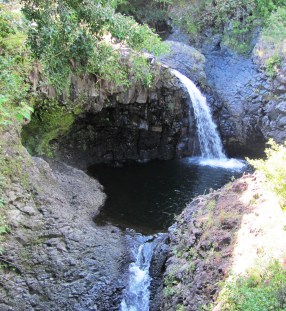
But what about Hawaiian rivers — would my [non-existent though well-intended] field notes on their DAILY WORK-A-DAY LIFE have proven our original hypothesis? Take a look and let me know what you think:

Aloha, my dear friends.