Category Archives: Uncategorized

… surviving your inner spring runoff.

It seems fast flows are muddying streams across the land – and so many of our personal lives as well. And that’s okay. Periodic peak flows are to be expected on any river. They are in fact essential for the river’s well-being.
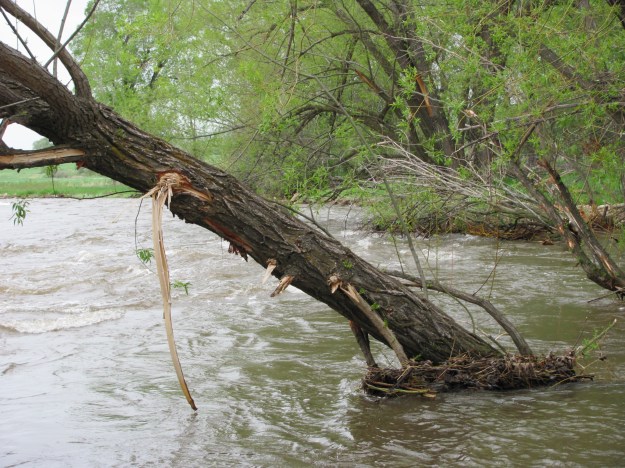
While the same may be said for our psyches, it is also true that a fragile river — inner OR outer — may begin to unravel during floods. Here are 4 tips for ensuring that you benefit from your personal flood without destabilizing:

River Runoff Recommendations

1. Utilize a huge floodplain. Allow lots of extra space and helpers (plants, animals, spiritual practices… hey, even people!) to help you spread out, slow down, and absorb excess, murky energy. Click here to see Sassy’s stunning example.

2. Alternately, you can be more independent and self-sufficient, as long as you have a rock solid foundation — and by that I mean you are accustomed to freeing your mind on a regular basis. Of course you can still reconnect with a lush floodplain full of other living things a bit further downstream. Click here to see how the Big Horn makes just such a transition in fewer miles than I drive when I cross it to get to the airport (and back… on those days when I miss the actual airplane)

3. When you feel not only clouded with fine sediment but also as if your foundation, your boundaries, indeed your very world is made of shifting sands, that’s also completely okay. Just  remember that when a stream is dealing with the small stuff, it MUST have luxuriant barbed-wire boundaries. Click here for more information – but only if you’re not too scared of cows.

4. If you run into truly extreme turbulence – a personal waterfall episode – then yipee! When a stream gets going super fast, it can change the actual physical “phase” or “state” of water – creating little bubbles of vapor (spirit) right inside the work-a-day liquid (psyche). Click here to learn how the rock-solid Niagara River uses this process to stay dynamic.

You see, even the most stable river is not static. It will shift — in a way that still allows the river to accomplish its life’s work and maintain its own particular character, albeit in a slightly different place and with the extra nourishment that can be provided only by the spring inundation. Rest assured that this is The Way of things, and that our own psychic floods and shifts are just as rewarding.

“The supreme good is like water,

which nourishes all things without trying to.”

Lao Tzu, Tao Te Ching #8, translated by Stephen Mitchell
… muddied

A favorite teacher writes:

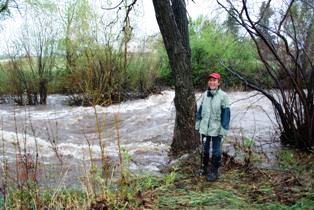
Lately, life “seems to be flowing very rapidly and creating turbulence. In my case, colleagues, clients, and friends have been living through experiences that pick up the goblet of my psyche and give it a good shake. The mud that had settled has gotten stirred up again. My theory is that by creating this disturbance, I can strain out more of the mud and create a clearer and clearer mind.”

And if our psyches are as much river as they are goblet, then muddied turbulence is especially essential.

A river’s life work is to carry sediment (“mud”) with its water (psyche/soul).

The faster the water, the more muck it can carry.

When the livin’ is easy…

Even in the calmest season, a classic river alternates fast, shallow, sediment-moving riffles with slow, deep pools where all kinds of stuff settles out. The river CANNOT be one long, clear pool. It would not function. It would not be a river.

And when it’s chaos…

The rhythms of stream life seem especially pertinent this month — to my teacher, her friends, me, my friends, PLUS the real-world rivers. During spring runoff, THE ENTIRE RIVER is moving fast and carrying sediment. Turbulently.

Peak flow

Typically, a stream’s annual “peak flow” matches bankfull in two out of every three years. “Bankfull flow” is the channel-forming flow. The river accomplishes the bulk of its work — during this one period.

Think of what you’re accomplishing during YOUR psychic runoff!

Sometimes the turbulent season hurts bystanders

Peak flow is always impressive.

And dangerous for outsiders IF they interact with the stream in the wrong way. Standing next to a swollen river is thrilling; swimming there would hurt.

Warn your loved ones not to swan dive into your psyche just now!

Building a permanent man-made structure in a stream’s floodplain is an even worse idea because about every three or four years, peak flow SHOULD exceed bankfull and flood the adjacent lands. Organic structures, like trees, weather runoff perfectly.

I leave YOU to decide which parts of your life feel like trees and which feel more like artificial constructs.

Because of the risks, humans try super hard to control rivers’ normal flooding — like with a dam that collects peak flow and releases the water gradually. Or levies that laterally confine flood flow in a skinny, deep canal.

The consequences of trying to avoid chaos

The river suffers.

  • Dammed rivers clog with silt because the channel never gets “flushed.”

The resulting deposition not only increases bank stress BUT ALSO suffocates fish eggs right in their redds (best fishery word ever — here‘s a nice diagram).

How many of us have buried our dreams in un-flushed psychic sediment?

  • Confined rivers run so deep and fast that their own artificially increased power requires they cut down into their own foundations.

It’s a desperate feeling.

  • Immediately downstream of both a dam and a confined channel (especially one lined with concrete), a stream does not have enough natural sediment load to match its speed. It’s hungry. It devours its own edges.

We have the energy to carry our life’s work too — we’re built that way! Without our own unique load, we turn our energy in on ourselves.

The living beings that surround the river also need the floods.

  • The most ironical consequence occurs when a dam breaks and kills people with the deluge. There surely were times when I held in my fast flows… and then busted. All over everyone in my path.
  • Most importantly, dams and canals eliminate the adjacent lands’ intermittent inundation with nutrient-and-soil-laden water. The rich riparian ecosystems and traditional croplands starve.

Life around us flourishes in the wake of our messy springs.

… so if it’s all good, then why do we feel uneasy about our chaotic periods? Because we know floods CAN hold dangers for the river itself. For our psyches.

But no worries, dear teacher and friends. Tomorrow we’ll glean tips from all types of streams on EXACTLY how to survive any high flow event.

Until then flood on, beloved muddy ones, flood on!

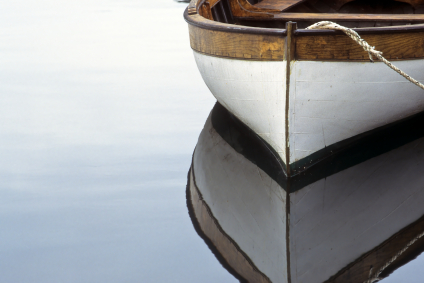
… who missed the boat.

That’s just plain silly. A river cannot miss a boat. And neither can I.

(Back story: I actually did miss a boat. Well, an airplane. Who does that?? There’s a long explanation in which I am a well-meaning innocent as well as another version in which I am bumbling and humiliated. The following logical points constitute my metaphor-gone-wild attempt to stop wallowing in either.)

Logical Point #1 — The boat isn’t going anywhere without the river.

My trip and all that I was meant to accomplish over the next few days – well, none of that’s going anywhere without me. I can’t miss my own life.

Logical Point #2 — A boat’s purpose is to carry someone across the river without getting wet. But the river doesn’t need to cross itself. And it LIKES getting wet.

If part of the trip was to skate across the surface of my life — ha. I cannot, and I do not want to.

Water is one of a couple dream symbols that Jung felt carried universal meaning — he called it the unconscious. A place where we are connected deeply to soul. Like a river, I enjoy soul inundation. And whadda ya know, here I am. Filled with my life.

Okay I feel a little better…

… thanks for listening. And when the airline sends you a Re-scheduling Notice the day before your trip,  always check the fine print (you know, like the tiny numbers after the word “Date”) to be sure they are not referring to your exact same flight at the exact same time on the exact same day of the week NEXT MONTH! Just sayin.

… already

Dear Like a River,

I hope you will get to writing about renovation soon because I seriously need to get a grip and would love to hear your advice on makeovers, river style!

— Ready for Renovation

My Dear R&R,

You’ve come to the right place. Folks of my professional persuasion have been fixing rivers for a long time. In fact, guess who our federal government deems “responsible for investigating, developing, and maintaining the nation’s water and related environmental resources.”

Yup, engineers, and not just any old engineers — the above quotation is the Google blurb for the ultimate authority over our waterways:  the United States Army Corps of Engineers.

The Department of Defense Against Rivers?

You may wonder why aquatic oversight falls to the army. Partly it’s because navigable rivers have been critical to our country’s political and economic success since our first battles for freedom, and, later, flooding rivers seemed to necessitate defense. But also it’s because our pioneering mindset cast all of nature as a battle-worthy foe.

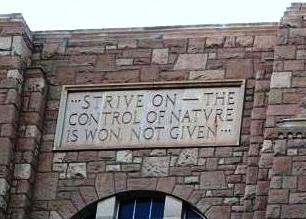
How do I know this? It’s etched in stone on Engineering Hall:

The Control of Nature

Such was the ethic back in the day. Some people still believe it. Some people hate it — until confronted with the flooding of Venice, a tsunami, or the loss of a culturally and economically critical seaport.

In his 1989 book titled…. drum roll…. The Control of Nature, my science/nature writing idol John McPhee chronicles three “places in the world where people have been engaged in all-out battles with nature.” All three battlefields involve water. The frontline is Louisiana, where “the U.S. Army Corps of Engineers has declared war on the lower Mississippi River, which threatens to follow a new route to the sea and cut off New Orleans and Baton Rouge from the rest of the United States.”

What would happen if we didn’t try to stop the Atchafalaya River’s natural progression — if we let it “take all of the Mississippi and become itself the master stream?” New Orleans and Baton Rouge would fail, at least according to one human definition of success.

The Most Dubious Nature of All

Is Nature – i.e., reality — our enemy? Must we fight to control it? Can we ever “win?” I mean, Southern Louisiana seems to be having troubles despite our fierce stall tactics.

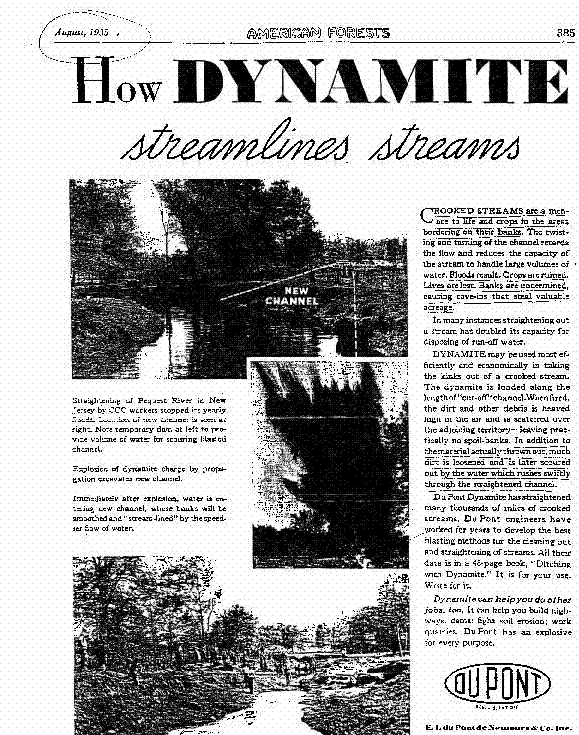
I suspect that you, my honorable friend, have a more objective and empathetic view of the way of the world. I doubt you’d ever deem yourself omniscient enough to dam a river with concrete or straighten a stream with dynamite:

(I have been looking for this old ad for awhile and found it on the rather spunky geomorphology blog for “emriver.” You can go there to view a clearer .pdf file.)

How ridiculous that anyone ever believed a naturally meandering stream to be “a menace to life.”

Yet.

I know that you, RR, like most of us, battle hard to control one particular part of nature – your own unique and human nature. What would happen if we didn’t?

I wonder why you want a makeover. Are you as unhappy with your innate nature as Dupont was with “crooked streams?” I’ve been there. Or are you looking to repair damage, perhaps even damage caused by ill-advised past interventions? I still do that.

But sometimes fixes don’t.

The damage the Control Ethic has wrought on our natural world, especially on rivers, is famous. Just so with our modern fixation on “self-improvement.”

And still…  I LOVE renovating a river.

This time around, hydrologists and engineers are using a new, HOPEFULLY improved, ethic: studying wild streams’ natural tendencies in order to work WITH a damaged river in restoring its health.

I hope we humans can be as kind to ourselves. We’re all basically okay, we’ve all been through some ordeals, and we all can trust our own wholeness as we navigate along.

I applaud your desire to be the best person you can be, dear RR. And I’ll definitely be posting some stimulating parallels in stream restoration – it’s my passion. Until then please know that the primary recommendation for stressed streams echoes your own pen name: R & R! So relax. Rest yourself from overuse AND ESPECIALLY from past “improvements.” And thank you SO MUCH for contributing to this work in progress.

Love to you,

Betsy

… fluent.

“Who holds the river?”

— LG (“Life is Good”)

My friend LG cupped her hands as if carrying water and repeated her question – which did not quite compute, striking me as somehow extremely beautiful and unfounded. Over the next couple days, I kept seeing LG as if through a telescope, forming the question with her hands. Each time, I felt my insides clear into light, easy warmth.

And then I left for the Northwest. My travels happily began with Alaska Airlines’ nationwide computer crash which allowed me plenty of time to soak in the Billings airport’s strangely soulful landscape and pull out my new operating instructions. Without any occasion, LG had given me a present: The Second Half of Life by Angeles Arrien. She said it was my manual now. The book flopped open to page 31 and this poem by John O’Donohue:

The other passengers likely thought I was crying because of the airport coffee (how would they know I love all coffee because it’s, you know, COFFEE) rather than the perfect non-answer to LG’s gorgeously unanswerable question.

And then the java kicked in. I went all left-brain, casting about for the hydrological truth. What REALLY carries the river? Each river is pulled by gravity, but that’s not the same as being “carried.” And each river is housed by this planet, but so is everything else – surely there’s a more uniquely riverine basis for the depth of O’Donohue’s insight.

Things That Could Be Said To Carry A River:

Option 1 – The Water

Technically speaking, stream water carries sedimentlittle pieces of earth.

Option 2 — The Channel

The channel – that specifically-shaped mass of earthen material – carries water.

So the water carries pieces of earth, and the earthen channel carries the water, but…

… wait – what IS The River anyway?

Some would say the water IS the river.

Yet we call an empty stream bed “a river” — albeit a dry river. Perhaps the channel IS the river.

Or maybe the river is both water and channel?

I say no. It’s the interaction between the two. The river is the container plus what the container holds plus the making of that container BY and FROM that which it holds.

The river is a phenomenon — ETERNALLY BUILDING ITSELF with anything and everything that crops up along the way as it moves through time and space.

Surprise

A river’s evolution is a surprise because it totally depends on what happens. It depends on the river’s fine interface with its surroundings — on how much water the river receives and how fast that water comes, on the buried boulders and roots encountered along the way, on the loads washed into the river by storms, on the lay of the land — and on the stream’s own power.

It’s no wonder scientists can’t predict a river’s journey or a human’s destiny, for as O’Donohue describes (in the introduction to Arrien’s book, not so coincidentally):

“… each of us has to inhabit his or her own soul in order to find out who he or she is and where the intimacy of his or her heart touches the world. No one else can tell you that; the maps that others have are of no use. Each life must find its true threshold, that edge where the individual gift fits the outer hunger and where the outer gift fits the inner hunger.

Experience is the arena where this whole adventure happens. The hidden structures of experience become the windows of being. This is how we unfold and enter deeper into knowing.”

This is the astonishing, ongoing realize-ing that carries us… just as fluently as it carries the river.

… koan.

Today I shared a meal with a striking professional woman. We discussed her passion for the second half of life, for healing trauma, and for giving all children the gifts of compassion for self and others.

She told me how on New Year’s Day, she walks to our river and asks “what do I need to learn?” Then she listens to the actual sounds of the river. The answer comes to her.  I was amazed.

We talked about how each person has their special river story. It always amazes me.

And then she cupped her hands together and said this thing that disoriented me. I mean linguistically, visually, spatially, chronologically. I don’t even know how to place it in my mind, but it gives me the shivers. She changed the topic when I finally regained enough regular consciousness to stammer out “what? What do you mean?”

So — if you know, please tell me. Or just enjoy the shivers:

“And who holds the river?”


… bankfull.

“If you don’t know bankfull, you don’t know shit.”

Dave Rosgen

No, the rock star of Natural Channel Hydrology did not email Like a River with this insight. He told me in person, a few years ago – just as he does each student in every class he teaches.

You’re likely asking, dear reader, what is “bankfull” – a noun, a verb? That adorable cowboy from the bar outside Lolo where Dave took us after the last field class?

What It Is — The Storybook Version:

Picture a classic summer river – a wholesome child fishing from the grassy bank, a picnic spread beneath the nearby shade tree. Each of these archetypal elements illustrates a hydrologic feature:

  • The fisher-youth sits right where the upward-sloping bank flattens out.

That exact spot provides a bottom-beckoning horizontal seat AND space below for outstretched legs. Hydrologists refer to this spot as the point of imminent flooding. When rising water reaches this level, it is JUST ON THE VERGE of suddenly spreading wider.

  • The picnic blanket is close enough to see and hear the river, yet the ground is dry AND flattish.

This (mostly) horizontal space adjacent to a stream is the floodplain.

  • The tree grows on the floodplain…

… because its roots are irrigated from below by the river’s base level BUT its trunk is submerged only rarely (about one out of every three years) and not for long (just the few weeks of peak flow, usually in spring). That natural “flooding” actually SHAPES the floodplain and ENRICHES it by depositing soil, nutrients, and seeds.

When the stream level almost touches the youngster’s sit spot, then THAT is what hydrologists call bankfull flow (or bankfull discharge but that word is kind of icky.)

What It Is — The Geekily AMAZING Version:

Don’t run away. What follows is mind-blowingly elegant (and not just because I got to use SHARPIES with GRAPH PAPER but also because I snuck in a hot link to the most poignant picture book ever… hover over the graphs to find it!)

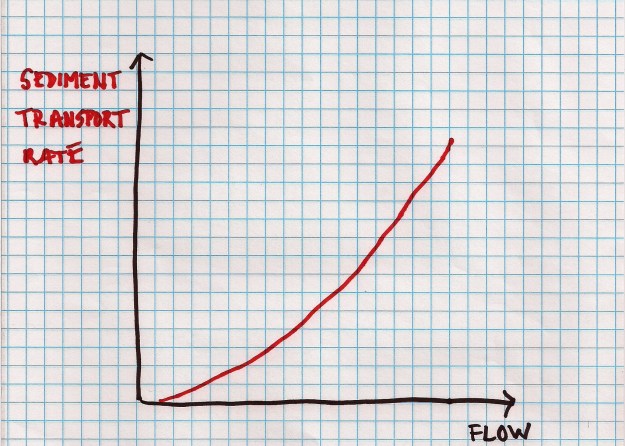
You remember that as a river’s flow increases, its power and ability to carry sediment also rise. This orange curve shows that very high flows move a lot of material:

But if floods are so powerful, then why aren’t channels carved to fit those HUGE flows?

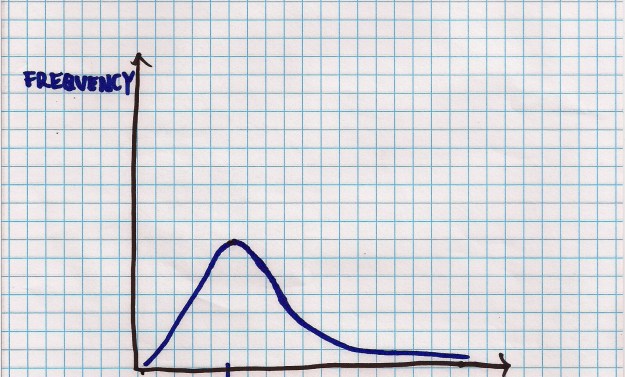
Because high flows don’t happen very often, as the next graph shows:

The trouble here is that the most FREQUENT flow is not big enough to fill most channels – or powerful enough to form those channels. [Sorry the x-axis label got chopped.. it should of course read “Flow.” But you knew that.]

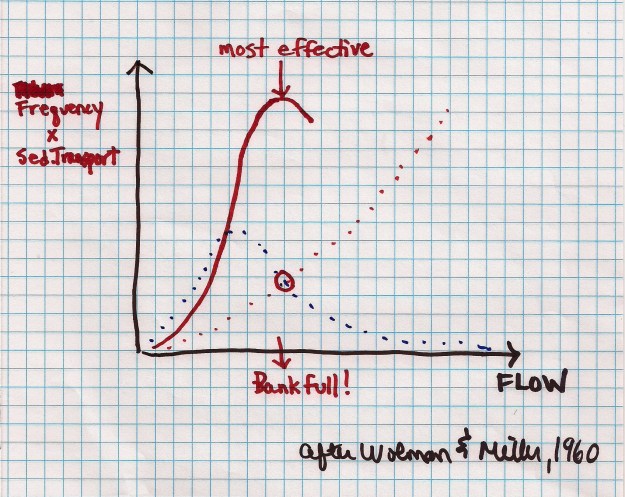
No, what we’re after is a river’s channel-forming flow — the one that moves the most sediment. We can calculate it by MULIPLYING frequency x sediment transport rate.

I have plotted the result in red on this last graph so you can really SEE the maximum value. Get ready because it blows my mind every time I use it in a PowerPoint (which is embarrassingly often) :

Notice I overlapped this graph with the first two? Notice the maximum, the most effective flow is where frequency meets power!? Ah. I told you it would be great.

Like a River…

… we mustn’t expect ourselves to be “at our most effective” in every single moment. Nor are we defined by our rare-but-epic episodes, no matter how great or devastating.

The times that shape us AND the times we shape the world lie somewhere in between — maybe during two-thirds of our peak moments — where our pretty darn strong power happens pretty darn often.

And guess what?

If you run that amount of energy down our storybook stream, it fills the channel exactly to the brim. When you know that, you know all kinds of #@!

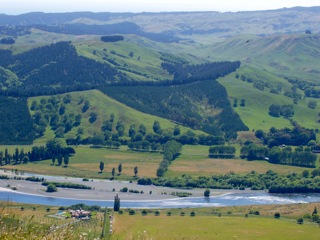
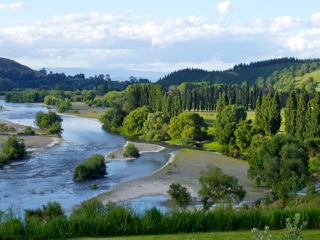
PS — Because you were so attentive through graphs and lingo and even some multiplication, here’s a piece of river candy. My uncle took this photo of the Tuki Tuki River in New Zealand. He was always the whip smart one in the family and now he’s all creative too. It’s a little intimidating for me, but you guys luck out:

Thanks Uncle Conny! XXX