Author Archives: Betsy Pearson

… rich

Dear Betsy — So maybe one of your other rivers could answer my question: at what point am I spreading myself too thin and how do I ensure quality over quantity! – The Strong Gold Heart River


Dear Strong Gold Heart,

What a valuable question. THE single most common river problem occurs when some event widens a stream’s channel, requiring the usual flow to cover more area than usual.  The broadening stream becomes shallower — literally “spread thin!”

Stretching out always forces a river to loose speed — a beautiful thing when it happens on the stream’s floodplain. But when it happens in the main channel, there’s trouble.

A stream’s power (its energy during any given period of time) is directly proportional to velocity. As it slows, the stream can’t do its life’s work — carrying clay, boulders, or whatever sediment is at hand. A human life’s work more likely includes preparing dinner, a joke, an account, a romantic moment, a book, yet another book… how do you know when you’re out of control??

There are two sure-fire ways to recognize a spread-thin river.

1st Red Flag: Aggrading

The stream drops its load. Right there in the middle of its channel.

2nd Red Flag: Degrading

Ironically, after the water lightens itself, it has EXCESS energy:

  • because it’s hungry (so the stream eats its own edges ragged); and
  • because the sediment wedge creates a drop off the backside (making the water more steep and powerful at that spot).
    • This falling water digs pools where there should be shallower riffles, and
    • as it erodes the back of the sediment wedge, the falling water slices its way upstream. Such “head cuts” create whitewater-like riffles even on bends where there should be calm pools.

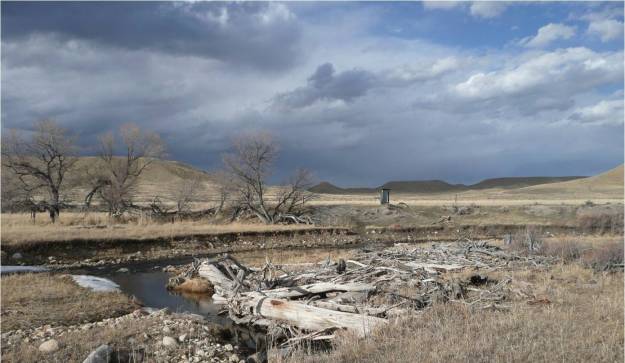
Here’s my own Big Goose Creek. You can see the sediment wedge turning into a center island, the raw stream bank on the right, and, if you look closely, some misplaced ruffled water characteristic of a head cut:

So in answer to the first part of your question, my friend: If your edges fray, if you develop stagnant piles of stuff where there should be easy flow, or if you’re tackling rapids where there should be serene water, then you are spread too thin.

How to ensure this doesn’t happen? I am preparing some specific stream-type energy management ideas. Meanwhile, I LOVE how human energy is portrayed in this guided meditation as a balanced braid of three “currencies” — physical, financial, and time.

We call someone with robust physical energy healthy, someone with abundant financial energy wealthy… and maybe Ben Franklin alludes to wholesome time energy in the final third of his phrase “Healthy, Wealthy, and Wise.” Because there’s really no synonym for time.  Nor a name for someone who tends the energy of time — unless, as with you dear river, it’s the one with heart.  Thank you for your letter, your precious support, and your priceless example to those of us who follow your adventures with awe.

“The only question is: Does this path have a heart?  If it does, then it is a good path. If it doesn’t, then it is of no use.” – Carlos Castanada

… live aloha!

I’m back from Hawaii but remember — I went to WORK!  My goal was to find wild rivers on whom I could test our hypothesis:

The most playful play IS rest. AND work. So ALL of daily life is… vacation.

Here are my field notes:

Fail?

My vacation reading list is an identically blank page; I spent zero hours on a computer; and since I was travelling with my two stoic male types, there wasn’t even much conversation. The week was weirdly wordless.

Weird because I like words. A lot. Reading them, writing them, scrolling through them in texts and tweets and posts. Talking them! Listening to them!!

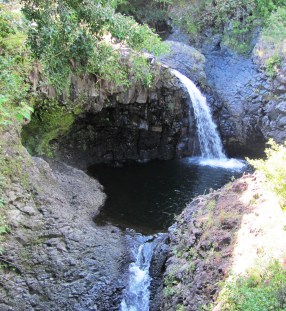
Instead I walked. Snorkeled. Slept. Splashed in waves. Slept. Hiked to waterfalls. STOOD in waterfalls. Slept. And, most wonder-fully of all, SURFED ( pix here!).

So, my week ended up mostly play and sleep. BUT physics-wise, you most certainly have noticed I ALSO performed work the whole time — that is, I was always moving something somewhere. For example:

• Paddling, paddling, paddling my board back out to the lineup. Okay there wasn’t really much of a lineup other than my son and Ricardo, our 49-year old Peruvian surf instructor (we were lucky The Sisters weren’t there since Ricardo had a whole Antonio-Banderas-as-ripped-surfer thing going on), but I must practice surfer jargon. The day said son graduates from high school, I turn surf bum.

• Expanding my lungs to inhale, then compressing them to exhale – over and over, loudly, through my mouth and into a tight little tube, while keeping my entire face submerged even though I’m scared of water. (Yes you read that right. Ironical? Or just fodder for a “feel the fear and do it anyway” post?)

• Casting my eyes from three whales blowing on the left side of the horizon to two breaching on the right while otherwise holding completely still in a lounge chair.

• Stretching smile muscles ’til my face hurt.

• Expanding my lungs to snore in, then compressing them to snore out – over and over, for 9 ½ hours each night.

While it doesn’t directly address our happy hypothesis, my trip proves this corollary:

A vacation is work — BECAUSE of the play — and therefore, deep rest.

But what about Hawaiian rivers — would my [non-existent though well-intended] field notes on their DAILY WORK-A-DAY LIFE have proven our original hypothesis? Take a look and let me know what you think:

Aloha, my dear friends.

… on vacation.

“Do rivers ever take a holiday?” — JJ Mahoney

Well, Mahoney dear,

This IS a science-based blog 🙂  so we’ll begin our inquiry with a definition of terms.

Vacation (full definition) — You go to an appealing location and rest a bit. Then play until you want to rest again.  Then rest until you want to play… in an infinite loop of bliss until the plane takes you back home to work.

Vacation (shorter definition) — You take a break from work.

BUT.  In the glorious and freeing world of physics, there’s no difference between work and play:

Work (official physics definition) —  You move something somewhere.*  This includes not just carrying your laundry up the stairs, but also dancing yourself around the kitchen or shifting your thoughts out of a well-worn rut.

So play IS work.  This doesn’t mean “ugh, there’s no escape from work.”  It means Yay!  Every fun activity that calls to you – do it.  It truly counts as your work.

Then what’s the opposite of work?

Not-work (logical definition) — When you don’t do nothin’ nowhere.

Not-work (shorter definition) —  Rest.

Not-work (cosmic definition) — wei wu wei or “doing not-doing”

Stephen Mitchell, in his translation of Lao Tzu’s Tao Te Ching (HarperPerennial, 1988), says wei wu wei “has been seen as passivity.  Nothing could be further from the truth.  A good athlete can enter a state of body-awareness in which the right stroke or the right movement happens by itself, effortlessly, without any interference of conscious will.  This is a paradigm for non-action:  the purest and most effective form of action.  The game plays the game; the poem writes the poem; we can’t tell the dancer from the dance. ‘Less and less do you need to force things, until finally you arrive at non-action.’”

So the play-fullest play IS rest.  AND work.  This makes all of life… a vacation.

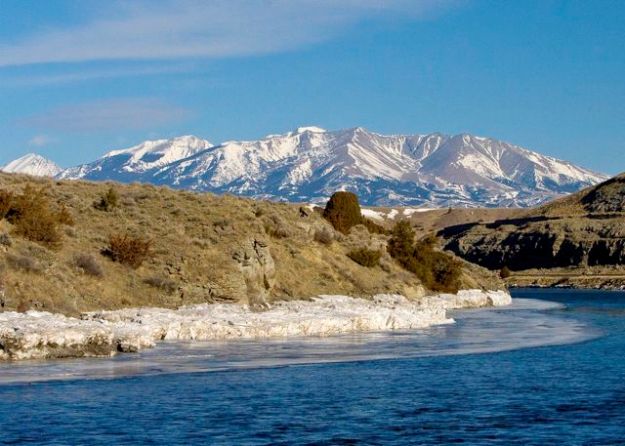
For the sake of science and your insatiable need to know, dear reader, I propose to spend the next week testing this hypothesis with some wild rivers.  The problem is that our Wyoming rivers are all frozen.  I am dedicated though, so I am taking myself off to a tropical isle to see what I can do!

While I’m gone, I invite all of my readers to join me, wherever you may be, in testing this  hypothesis.  Send me a note with your results — which part of your work feels like play? Does any of your play feel like work?  And what about rest??  I look forward to hearing your adventures.  Til then, keep on doing that not-doing.

Betsy “Yohoney”

PS — Computer time’s likely to be minimal in paradise, but I will post a bit of river candy now and then!

* for TheWorseMother.com, who is not only tied with hyperboleandahalf.com for blogger- that-most-enhances-my-life but also VERY GOOD AT MATH, here’s the equation:

W=Fd

Where…

W = What else but work.

F = For sure not the same thing as the F in her AF**GO University (!) but just the force that moves something.

d = distance.

… sassy AND fast???

“Wait, wait, wait — is today’s post saying I can ONLY have healthy “multiple channel flow” if I go slow and am all level, all the time?! Please answer ASAP.”

— Split

Dear Split,

Excellent point!  I should have clarified that each one of the eight basic types of rivers can be absolutely stable AND fabulous IF it flows over, under, around, or through a world of big, solid rock.

What does that mean for a human being??  Read about it here.  Then check here for a glorious visual of just what you’re after.  Don’t worry — I have a strong hunch you got this going on already!  And thanks for your follow-up. XXX —  B

… split but not crazy.

Dear Like a River — My life doesn’t fit the model of a stream channel! It’s more like maybe ten at once. There are my kids (homework, practices, fruits & vegetables, suitable friends, clothes that fit, feelings, dreams, and socks, oh the socks…), and my job (sometimes I actually bring the kids, depending on when, who, etc…) plus love life, work-outs, friends (I CAN’T do without them, luckily I get to see a couple at work and in yoga class), parents (my mother-in-law lives with us which is actually helpful), and this tantalizing little side interest that’s maybe, hopefully evolving into a true vocation. See what I mean? — Split

Dear Split,

I have two friends, Crazy and Sassy, who both flow through multiple channels every single day.  But any similarity between them ends there.

Crazy:

Mostly she’s crazy-beautiful, but at times she falls apart. Then Crazy Woman Creek is unable to carry her load. As you can see, she begins dropping rocks and dirt all over her bed. Her channel becomes shallow thereby decreasing her stream power so she’s less capable of doing work. Eventually an unnatural island forms right in the middle of Crazy’s life. It divides her energy between channels, further diminishing her power, then the additional deposition acts like a low dam and flattens her water surface, forcing the stream sideways. She erodes her own ragged edges:

Sassy:


Sassy does multiple-channel-flow in the healthy way: anastomosing. You can see she’s more like a system of many stable, narrow, deep streams. The sometimes twisting branches join, split, and reconnect in a continuous network across a super wide, very flat, extremely well-vegetated floodplain. The friendly plant roots stabilize her banks. The Saskatchewan River’s  whole environment is lush with LIFE: insects, mammals, and everything in between. Plus she’s super accessible. You can walk all over that flatness as long as you don’t mind being damp. It’s wet everywhere even though you’ll rarely find a serious “rapid” or any water deeper than your waist. And best of all, Sassy functions beautifully – she can do her work — which for a river means transporting sediment. As a result, her banks and bed are stable.

How to be Sassy:

• Each separate part of your life must be deep and narrow — focused enough to move a load on its own. But let some of those branches turn and meander almost tortuously. That’s part of Sassy’s charm and stability.

• Like Sassy, draw support from the roots of your friends.

• Those roots will depend, in turn, on your energy. Because of interconnections, if there’s any water in Sassy’s stream, those roots get it too. If one channel gets blocked, water flows another way. That’s why so many lifeforms have this same pattern – blood capillaries, leaf veins — and why you, Split, seem to be doing pretty well. Your mother-in-law helps with the kids who can also sometimes go to work where you also see your friends who you may see later at yoga.

• This life needs a steady and unhurried pace. Sassy, her banks, and her floodplain are all pretty flat, so everything’s evenly irrigated. Furthermore, the gradual slopes create very little erosion force AND allow plenty of time for water to soak in.

• Sassy can handle a flood for the same reason – lots of level space to spread out and slow down the floodwater. If you want to run in multiple worlds, be sure the overall cross-section of your life gives you room to overflow when inundated.

• Avoid building walls. Burying or filling any part of Sassy is the beginning of her end. Imagine elevated roads, railways, or “flood control berms” cutting off her channels.

When we’re part of a community, branching from and joining into others lives in our own healthy way — well, not much can disrupt that kind of well-being. Thank you, Split, for the reminder.

… side ways

“I need to slow down some — any recommendations dear rivers?”  — Hatt

Dear Hatt,

Look around a bit more.  Poke around over there, visit over here — and then maybe somewhere else too.  You will see more country, and those places will get to discover you too, so that’s a plus for them!  Think of all those otters and moose that get more shore time.  Wait – what kinds of riparian critters do you have out there in your area?  I suppose that depends on elevation…  are you near those salamanders?  I doubt you have moose.  But you know what I enjoy almost as much?  Little humans.  Just the way they move around is so darn cute.  I think even the fish like them — as long as their folks use barbless hooks;) Those things are the best invention ever. Anyway, many joyful wanderings!

— Happily Unnamed Tributary of Pole Creek

Happ (hey are you guys related??), in her typical circuitous fashion, actually is onto something.  You see, all streams must dissipate energy somehow.  This is where they, like all phenomena in the universe, obey the second law of thermodynamics and increase the world’s entropy.  (Although entropy is also called disorder or chaos, remember it’s not necessarily a bad thing!)

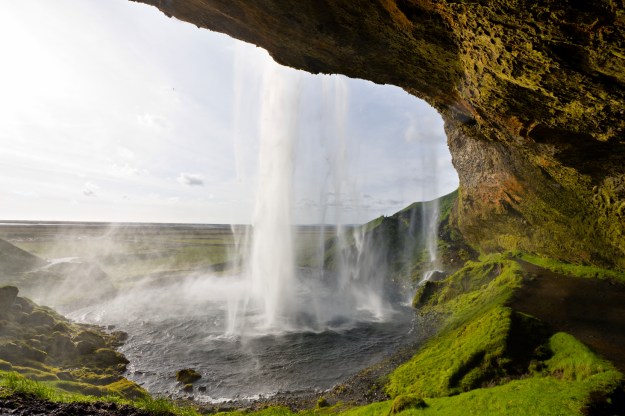
Streams like Wailua Falls use steep steps to dissipate energy in a vertical direction.  But streams with flatter slopes introduce their disorder sideways, by meandering.

The inverse implication, as Happ suggests, is this:  if you introduce more twists and turns into your river, the slope WILL become more gradual.  Because the energy is expended side-to-side, the stream does not NEED to get rid of more through a lot of downs and ups.  The pace becomes more relaxed.  And — bonus! — you get a super classically photogenic stream/life:

So flow off in a tangent, dear Hatt, then switch your bearing again.  These adventures can be new endeavors in the outer world OR new ways of thinking inside your own head.  Both kinds of exploration will allow you to enjoy a more leisurely tempo — plus all us critters around you will benefit from your lengthened presence! Aaahh.