Author Archives: Betsy Pearson

… The Quiz has arrived!

What Stream Type Are You?

Natural Channel Hydrologists classify streams into eight basic types. There are powerful, dramatic waterfalls and cascades; resilient rapid-dominated streams; classic and hard-working rivers with riffles, pools, and point-bars;m braided rivers; incredibly lush and stable anastomosed channels; sinuous meandering streams; deep and inspirational rivers; and steep, transitioning streams.

Each type has strengths, vulnerabilities, and a few tips for how to live your best life.

To take the quiz and receive a copy of the profile and photo of YOUR stream type, click here.

… compelled

Like a river, you are pulled by an unseen force even when you don’t know what it is (or aren’t sure it exists). I find the best way to discern the SPECIFICS of anything’s true passion/purpose/wild nature is with Bev Barnes’ quintessential question:

“What can’t it NOT do?”

What’s a river (or you) compelled to do/know/embody even when not trying, when doing something else at the same time, when not paid or thanked, when no one knows, when discouraged, when asked not to, when time and money are not an issue, when free to do anything in the world?

All rivers flow downhill toward a sea.

Rivers don’t TRY to flow downhill — they can’t help it. They’re pulled by gravity, and every river wonder comes directly from that fundamental part of their nature: the billowing spray of Niagara Falls, the sculpted layers of the Grand Canyon, the grassy meanders of a mountain creek.

What can’t YOU not do? Maybe you know the answer right away. Sometimes, though, you can’t see your greatest power because it’s so innate that you don’t think it “counts.” Ask your friends what they see. Or look at your whole life — all eras and aspects — and compare yourself to a river using these questions:

  • When do people turn to me for help? Throughout history, when folks have wanted to move cross-country easily, they’ve hopped onto canoes, inner tubes, or barges and let the downstream current carry them.

Sara’s friends always call her when they want to create the most fun, most affordable travel adventure — she knows the latest booking secrets, the quirkiest destinations and their signature activities, plus every organizational trick invented (because she invented some of them).*

  • What have people tried to stop me from doing? Humans often try to stop rivers from flowing downhill (or make them do so with less speed or in a narrower channel or on a more indirect path). It never works forever – the stream always and eventually finds a way to keep doing what it can’t not do.

I sometimes try to keep my busy, professional husband, Freyr, from planting things. This may sound mean and downright anti-nature, but he’s built raised-beds of perennials outside government housing we occupied for less than a year, rooted cuttings (in our drinking glasses) and avocado pits (usually in tin cans for some reason) on every flat kitchen surface, sowed wildflowers on the neighboring golf course property (hello PoHo… you don’t read my blog do you?), and planted trees on adjacent road right-of-ways, private pastures, and state land.

  • What aspects of me do people harness for profit? One reason we humans dam water is so that we can use its natural downstream movement to generate power – electricity for lights and machines — and enjoy the resulting opportunities and cash flow. When have bosses, loved ones, or frenemies pulled you in on a project to benefit from your particular style?

Mark may be the owner of a software company, but he’s still the person that every employee calls to invent an as-yet-to-be-identified new product, get rid of a persistent and undiscovered bug, or calm flaring personalities (whether they be the visiting UPS guy or the CFO). Normal daily functions and easily-solved problems are of no interest to him.

  • What am I happy to do for others at anytime and for free because I like it or it feels like no trouble? It doesn’t trouble the river if a kayaker rides a rapid or even a waterwheel grinds grain or generates electrical current (if it’s built right — but that’s another blog post!).

Jessica will always put together the perfect playlist for any particular person and occasion. She can do it in a flash because of her vast knowledge of all kinds of music and her intuitive understanding of people’s needs and personalities. And she loves it. Truth is she’d be messing around with iTunes anyway!

  • What activities feels like they “come through me” — like I make very little effort and still get amazing results? Water channels gravity; it doesn’t make it up.

Michelangelo said “I saw the angel in the marble and carved until I set him free.”  Katie feels the same way when she starts writing or talking about food – like something wants to be said. Her task is to stay clear and willing enough to let it arrive. She’s often surprised to go back and read what she’s written, and I know her descriptions of a “lovely asparagus” with a “delicate” something-or-other always inspire me to eat and cook better.

  • What am I like when I give up and go with the flow? How could I act all day long, every day if given the chance? What DO I do, right now, all the time? Rivers aren’t aiming to be something they can’t. Nor do they ever cease their flowing.
    • Your passion may be a particular subject (travel adventure, plants, computers, food).
    • Or it could transcend subject and be a unique set of skills. Sara and Jessica remember things, match them up with the right person, and/or organize them — whether those things are airline tickets, songs, ideas, closets, or other people. Freyr can start and heal most anything. Mark’s a solver of any super thorny problem and an innovator. Katie can apply adjectives to any topic in a way that makes my mouth water and my heart feel glad.
    • Or perhaps you’re like Jamie, who can and has done almost any activity — paint it, hike it, climb it, ski it, write it, collect parts of it, teach it, build in it — with regard to almost every aspect of one place (“where the mountains meet the prairie” in beautiful Sheridan County, Wyoming).
    • Or like Claire, whose defining trait is her character – her warmth. People pay just to be in the same room with her no matter what she’s up to. What are you known for? Your bravery? Calm? Laughter?

Your true wild nature is always there within you — whether or not you know it – shaping you and your world. Naming and understanding it is not essential, but it’s fun. And you can’t help but be ever more glorious (and happy and highly productive and properly compensated!) when you let your innate power pull you, like a river does.

*Note to my friends/family/clients: I changed your names. And maybe your gender. Or maybe this is not really you? Either way, your secrets are safe with (and deeply beloved by) me.

… mourning

Maybe you can tell me how rivers grieve?Taescach

Beloved Taescach,

How is any being — even a river — to bear the loss of a soul mate? I so wanted to ponder this for you and with you, but first I had only more questions… does a river ever face loss? Who might the river mourn?

Luckily, I have you to fall back on. Sometime before we needed it, you penned the answer to these questions:

“A soul mate is someone who expands your soul’s capacity to love.”

And a river does love.

In fact, the river becomes itself through love.

The river accepts every >rock, >climate, and >valley encountered in following its calling to the sea, shaping its very course…

… >from that earth

… >with those given rains and snows

… >using the lay of those particular lands it must cross.

What nourishes the river’s ability to grow in love like this?

In other words, what is a river’s soul mate? A first I thought of bedrock, as it opens up possibilities for any stream…

… and yet a life’s underlying foundation is not distinct from that life, nor has it the vitality I see characterizing a like-spirit.

Then I remembered that there IS one kind of living companion found alongside every healthy stream and actually imported by river workers to heal wounded streams:  deep-rooted, woody vegetation. It’s a long name to whisper to your soul mate as you lie full length on a stream bank, but try saying it all in one single, sacred breath, as hydrologists do. Or simply smile up at the branches and sigh, “tree.”

This soul mating is a deeply shared, old development.

A river is capable of behaving like a river only if it has banks. Recent geologic research found that “until the evolution of tree-like plants, some 330 million years ago […] ancient waters flowed wide and shallow over the land.”

Water that’s spread thin and broad must move slowly. A prehistoric “river” was forced to conduct its life journey as an indeterminate slog.

AND the poor soil was inundated all the time — life forms (like trees) preferring drier conditions definitely did not feel loved by the waters (or even allowed to develop) until:

“… larger plants needing deeper roots stabilized river banks and forced rivers into narrower paths [… between] river banks that provide trees with easy access to water, without the constant risk of flooding.”

Rivers thrive on trees and vice versa.

In this way, each soul mate increases the other’s capacity to love through their own capacity to love… which is increased by the other’s capacity to love:

tree roots strengthen river banks which nourish tree roots

The co-evolution of trees and streams reveals exactly how a soul increases another’s capacity to love: through his/her own capacity to love.

The process is so interwoven and reciprocal that it’s hard to tell which act of love came first. A river nurses a tree’s roots by allowing them to sip water from the high safety of its banks, while the tree’s deep roots are vital in reinforcing the river’s ability to build those very banks. We’re the same way. Giving and receiving love, nourishing and embracing one another gives us greater self-definition and health, allowing us to care for one another even more deeply.

§

A singular loss

Taescach, you have lost an epic prairie tree from the bank of your river.

How can you survive such a loss? Once again, I turn to a river for an answer.

Not too long ago, flames engulfed the Cottonwood gallery along Tongue River about 30 miles north of where I live. Many wonderful trees were killed in the firestorm.

Two weeks ago — two weeks ago! — I was called to visit a bend in the stream where one burnt, particularly magnificent, particularly river-connected Cottonwood had fallen. Its mighty root system was ripped out, laid bare, and so intertwined with the stream that a giant chunk of the river’s bank was uprooted along with it. What remained was a huge hole exposing a heretofore private world of soil layers, ant tunnels, and tiny smooth pebbles.

The river bore straight into the vulnerable negative space, eroding itself. Raw.

I have a hunch you are familiar with this feeling.

Eventually — with much erosion, deposition, course changing, and slope adjustment — this river would end up stable once more. But only after a long time. And the new channel would be very different indeed.

Luckily, Tongue River, like you, has its soul mate to fall back on.

For even in death, the Cottonwood’s roots will heal the grieving river.

Hydrologists call this restoration technique root-wad revetment: embedding the fallen tree’s trunk and bare root-wad right into the river’s wound.

In beauty, splendor, and glory…

Please know that revetment is not the same as pretending you can plug the hole with some inadequate substitute and move on as if nothing happened. No. There has been a loss.

What revetment (originally “re-vestment” from re-vestire) DOES mean is “to clothe again.” Though something beautiful has been stripped away, the river can clothe itself once more in beauty — a different vestment, to be sure, but one still specific to the two soul mates. Still holy.

Here’s how:

  • First, trim away the fallen tree’s remaining branches. It’s an excruciating process, but those limbs and leaves were made to turn sunlight into sustenance — an alchemy they cannot and need not perform in the tree’s next incarnation.
  • Next, lay the bare trunk horizontal, turn it around, and bury it in the bank with the deepest roots facing outward, into the river it loved so well. What was above ground gets embedded, deeply stabilizing the bank, and what was hidden is now open to the elements. 

When raging, the river rushes directly against, in, and through the exposed root complex. The water’s exploration of the intricate geometry absorbs some of its intense energy, and the root-wad directs the bulk of the river’s flow toward the center of the river channel, away from the vulnerable bank.

During lower flows, the twisty, turny roots hide fishes and insects from hot sun and predator eyes. Slowly, through all seasons, the river and the many lives it supports can mend, thanks to the loving embrace of its fallen soul mate.

§

Like a Cottonwood, Jon gave you just what you need to grieve: two capacities for love, both expanded while you and he shared soil. When you feel your capacity eroding, you can lean on his — for your radiant words, actions, and intentions in this difficult time have let that beloved root system become part of you in a new, still soulful, skillfully appropriate way.

I am sending you love, Taescach, treasuring thoughts of you, thankful for your presence now as always,

Betsy

More than a year later: I revisit this piece because I myself am in need of healing.

I look back at how Taescach  followed the same steps hydrologists employ to repair an injured stream.

Taescach and Jon’s other friends and family first focused on settling numerous vital but ultimately transient details — the “leafy branches” — of Jon’s life. Much of this necessary clearing away happens automatically after a loss, but some work usually remains, especially when the loss is a death: not only distributing the loved one’s belongings and canceling routine appointments but letting go of treasured plans and even interests that nourished that loved one but are no longer needed in your life.

After that initial reconciliation, Taescach began her more personal healing. She embedded Jon’s most visible and sturdiest aspect — his kick-ass, protector-of-right, risk-taking, fun-loving, warrior ethic — deep inside her.  The world might not see the “trunk” underpinning T’s intention to engage all of life with a fierce joy, but Jon’s famous essence remains within, always available. She felt fortified forever.

As for the deeper ways in which she and her beloved friend nurtured one another, those once-private “roots” are what Taescach has turned outward to the world. She reached out caringly to Jon’s family, paid rich tribute to his life through spoken and written word, and offered increasingly thoughtful acts of devotion to her husband and children.  She reset Jon’s precious roots of love into her life. In this new but still soulful way, the two soul mates continue to increase one another’s capacity for love.

~

Some engineers try to armor damaged rivers with concrete walls or wire baskets full of rocks. It doesn’t work. Hardening banks with artificial structures merely forces the erosion downstream. Root-wad revetment is effective because it incorporates nature’s own laws and materials.

The same is true for a human soul. Hard shells protect no one. Only love — that most compelling natural phenomenon — can handle the variable currents of life. This is what I’ve learned from watching Taescach turn loss into life, from seeing how she enlarges those around her as she grows in power and resilience. She armors herself in love. Like a river.

I am using her example to speed my own restoration after a loss, and you can too —  whether you’ve lost a beloved person, animal, place, ideal, or era and whether by death or other means — by considering these questions:

  • What branches and leaves power[ed] your beloved’s existence but did not directly, deeply touch your relationship? Let them go. A new chemistry is at play.
  • What’s your beloved’s most massive, obvious, central quality? Whether this trunk is a core value, an attitude, a set of skills, or a feeling evoked in all who set eyes on your beloved, plant it deep within yourself. Draw on it.
  • What were the secret roots through which you and your beloved cared for one another? Turn them outward. It seems counter-intuitive. But whether it be fully open giddy smiles, a private game, outdoor naps, or the ability to actually pull one another into the moment with a word, those things are most fully love. Clothe yourself in them and you heal not only your own soul but the world around you.

… traumatized.

My Dear Readers,

A friend of mine’s family recently went through an ordeal — a human version of when a river “gullies” into a raw chasm.

An extreme example.

I am not saying my friend’s situation is this injurious, but either way – for rivers AND humans – even a “small-scale” trauma is painful.

She fears that neither she nor her beautiful son will ever be the same.

On some level, we never are the same after ANY experience, day, or moment.

But this family is dealing with something acute and damaging, so my friend’s specific fear is that they each will be changed for the worse — messed up.

It can be tempting — especially when you are not the one involved in a crisis — to assert that no event is inherently bad or damaging but rather part of life in ways we can’t understand and that we must adjust our thinking about the event.

In river work, it is certainly true that healthy, natural processes always involve change and sometimes look decidedly not-pretty to a cultivated aesthetic. For example when a river bumps up against a high terrace, an exposed, vertical bank is to be expected. This is not problematic.

But such a default assessment negates the very real experience of trauma – to rivers AND to people.

Hydrologists know that rivers can indeed be harmed:

And hydrologists define a destructive event as one that destabilizes the river.

Stability and instability:

A stable river is one that maintains function — transporting its water and sediment load — without changing its basic form and type.

A stable river does change and move. You can see how the Pecatonica River [a classic E-type stream] migrates back and forth across its valley over time in a gradual manner. But the old channels show that the stream maintains the same pattern (curve shapes), profile (slope), and dimensions (width and depth) everywhere it travels:

[Image credit: Louis J. Maher, Jr. photo 156-07.]

Alas, ugly events can destabilize any river, altering its form and function in ways that most typically include degradation. The stream is scoured down through its very foundation in the affected spot. Layers of earth are exposed in an entrenched, narrow space.

That’s trauma.

The Great News:

Even the most significantly damaged river will heal. Always.

How quickly a stream recovers its stability will depend on what happens after the initial damage — it’s possible to speed the process along – but, even without assistance, the stream will mend over time.

How a gullied stream heals itself:

1. A recovering gully first evens out its slope. Ironically, this natural accommodation actually causes MORE erosion in the short run as the channel “head-cuts” through its bed.

The first and crucial step in healing human trauma is also to smooth out the jagged edges — that panic gouged into the body by a cocktail of stress hormones designed to make us fight, flee, OR freeze. As Belleruth Naprostek describes it: “These biochemicals in the bloodstream don’t dissipate quickly, but instead they swing back and forth like a pendulum, between releasing alarm and sedation neurohormones, in an automatic recalibration to get the body back into balance. People can be furious or terrified one minute – that’s the alarm biochemicals – and numb and disconnected the next – that’s the natural opioids.”

In the first 72 hours following a trauma, it’s super helpful if the person who experienced trauma can clean out those hormones and the associated residual biochemical gunk: move a LOT, rest a LOT, and relate the story of what happened. Perhaps many times.

2. Once its profile regains a uniform average slope, the stream will begin widening its gully to provide room for meanders and a flood plain. It craves spaciousness. The stream achieves this breathing room through the benign-sounding process of lateral migration; however, once again, the short-term reality of the healing process actually causes more erosion since the stream must cut into its side walls. It carves bigger boundaries.

As I do more research into healing human trauma, I hope for a clearer idea of the human parallel – of how we broaden our lives after a trauma and how that more expansive life allows us to meander through different explorations and to build places where our lives can safely overflow in future times of flood. I want to learn how we can support one another in such restoration. I will keep you posted.

For now, I am content to know that healing is inevitable. And that traumatized rivers end up functional once more, fully restoring themselves albeit at a much deeper level. Literally. Which is why they are so gorge-ous and beloved by us all, even while they are still in the midst of restoring themselves… like the [F-type]  river pictured below and some of my very favorite people:

… expressive.

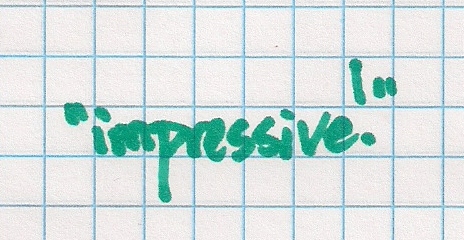
“How impressive!

— My personal mantra the other day

I spent the other day surrounded by some very impressive folks.

Yeah, I felt some pressure.

At 7:35, the pressure was situated in my brain, perhaps because I was formulating a pretty DAMN impressive To Do List for the following day — a list designed to further an even more impressive 5-YEAR PLAN that I devised while watching the others multi-dazzle with freshness before the coffee was even served. By 7:45, I felt like those Roman shipwreck salvagers at 380-ft below sea level. The pressure was all around me:

Not a pretty picture.

I was focusing my energy in on ME. No wonder I felt the “in-pressiveness.” AND — what’s worse — you can see how I was sucking away at the world. So much for the virtues of meekness.

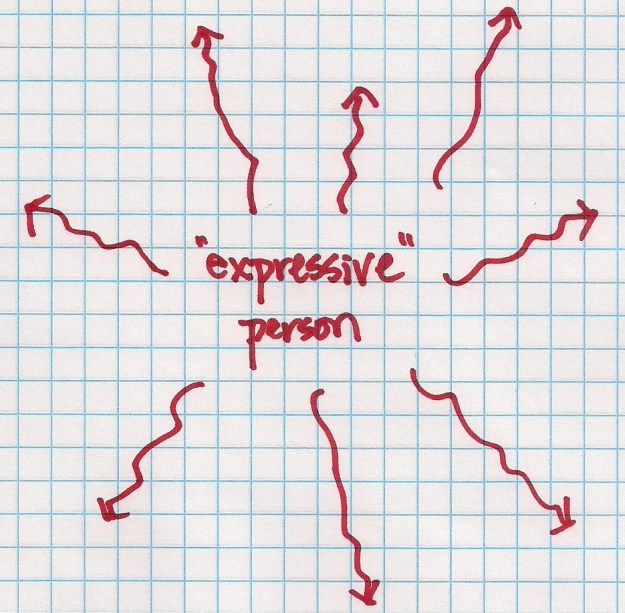
Then I noticed that those folks I was admiring actually had a very different look. In fact, they were the opposite of impressive:

No internal pressure here. Expressive people extend out, giving to the rest of us.

These are the people we like to stand next to.

We want to bask in whatever they’re putting out.

Champagne Falls

River water too can experience very low internal pressure. When it does, something miraculous develops — actual inner space. Bubbles!

If you live like water, there are two ways to lower your internal pressure:

1. Movement — You might remember how awhile back I thrilled to discover that rivers pick up enough speed to bubble when they leap into space.

People who live as straightforwardly as waterfalls have no time to im-press.

They are going all out.

2. Temperature – Heat up your life with passion and you can’t help but share it. Watch your life expand.

And let me thank you in advance on behalf of the world…

… we need your expressiveness.

… mixing domestic, wild, and barnyard metaphors (because organization’ll do that to even a river).

Remember when our Dear Organizational Guru asked:

“How does a river organize itself?”

The river doesn’t have a brain, a laptop or any one central intelligence. And yet it ALWAYS creates something supremely gorgeous and functional.

The river’s secret…

… is what mathematicians and scientists call self-organization. Rather than sprouting from one primary unit, a river’s patterns and structures are created by local interactions of components in a way that’s:

  • parallel — all of the local interactions occur at the same time — and
  • distributed — no one element coordinates the process.

Sweet Example: Point-Bars and Pools

The structure —

Stream meanders develop sediment bars inside curves and pools with cut banks on the outside. You can see how this pattern develops throughout a river system :

Stream Type C — Blue River, Colorado (stock photo)

How it works —

The point bar is underwater during peak flow, at which time it shuttles sediment like a conveyor belt. As high water recedes, the river drops most of its sediment load, and the bar sits exposed… until the next spring flow covers the bar and mobilizes the sediment once more. This cycle means plants can’t really root on active point bars.

The battle against nature —

It sounds silly to fight a river’s self-organization, but pretend YOU own a lovely little piece of paradise. Imagine that one side of your stream bank keeps reverting to bare ground and the other side to a vertical drop-off into a deep pool. You might try to “stabilize” and “beautify” the point bar with transplanted willows like someone did with this well-intended but misguided restoration effort:


See how the creek scoured around the willow transplants? Interference always requires exhausting maintenance because the creek continues its natural self-organizing behavior.

But even worse, if the interferer perserveres and “succeeds,” the artificially imposed organization creates a nightmarish domino effect.

For example, if you armor a point bar with vegetation, then you prevent the river from moving sediment across the bar. Instead, the river actually builds the bar higher which narrows the river’s width and down-cuts the river bed — destabilizing the river’s profile far upstream and down.

A solution that will L.A.S.T. —

1. Look.

See intrinsic patterns and structure (aka reality) rather than imagining how the world “should” look.

2. Acknowledge .

Say to yourself, “Wow! This thing must be self-organizing around natural principles!”

3. Surrender.

Decide you like the natural way — love yourself some bare-naked point-bar!

4. Take a page from nature’s book.

If there’s an instability you really DO want to fix, like the raw bank on the other side of your imaginary creek (and the creek pictured above),  then look for OTHER natural principles to help you out. For example, the would-be-restorers might have noticed that banks erode more slowly to the degree they are:

  • separated from the low flow channel by a low “bench,”
  • well vegetated, and
  • at a less steep slope.

In the above photo, you can see they DID build and sod a low bench next to the eroding bank on the opposite bank. Yay! It would have been even better if they had sloped the vertical bank and sown some native grasses on the incline, but it might still heal over time (I’ll take some photos this summer and let you know).

Sour Example: Shoes, Pens, and Hair-ties

The structure —

Shoes clutter the corner of my home’s entry; pens litter the coffee table; my daughter’s hair-ties tangle into a nest on her bedside table.

How it works —

Residents — apparently raised in barns, by wolves – drop stuff WHERE THEY STAND WHEN FINISHED (WTSWF).

The battle —

I relentlessly nag advocate for a more civilized principle: stow items at their POU (Point of Use). Yes my ‘advocacy” exhausts us all and has a nightmarish domino effect.

LASTT’ing success

1. Look.

Okay…I see PILES OF STUFF. Hmm. But they ARE sorted by type of stuff! Interesting.

2. Acknowledge.

The house IS self-organizing in a parallel and distributed pattern resulting from the local interaction of elements according to a natural principle (WTSWF). Or should I say WTF.

3. Surrender.

Fine.

BUT I don’t like the messy vibe! And if Mama Wolf ain’t happy… it needs fixing.

4. Take a page from nature.

I notice that sometimes barn-raised wolves will put things in a container if the container is both WTSWF and pre-seeded with like objects. So I put a handsome, sturdy basket in the hallway and salt it with some sandals; find a cute pen canister for the coffee table; and throw some old chipped, cup-less saucer on my daughter’s nightstand because that place is hopeless anyway.

5. Take as many pages as you need!

Since stuff is not at its designated POU when the baby wolves want it (i.e, in their closet, desk, or bathroom), I could apply some other natural principles like my favorite: “if you want to act like a barn animal then you can run around like a chicken with its head cut off finding your stuff in the morning”

But sometimes the natural consequences principle feels too harsh considering that IF they were raised in a barn by wolves AND I’m their mother, then… what does that make me? At fault, of course! In the midst of maternal guilt fits, I might pity the hapless lambs, invest in another set of containers to place at the POU, and swap them out when the WTSWF cups runneth over. But that’s entirely dependent on my whims — one of the perks of being the alpha wolf! It’s always your own call, my fellow river wolves. Just don’t fight nature, especially your own. XXX

…salting inside.

“All streams flow into the sea…” Ecclesiastes 1:7

All things end in the Tao as rivers flow into the sea.” — Tao Te Ching # 32

Love is like a river running straight back to the sea”– “Love is Like a River”

The sages agree:

King Solomon, Lao Tzu (via translator Stephen Mitchell), AND Stevie Nicks define the sea as that place where the rivers end.

The sages apparently never visited Nevada.

I’ve lived in lands where rivers never make it to the ocean – confined, arid, lands where rivers haven’t had the time or fluid energy to bust through surrounding mountains. Those rivers terminate right inside their homeland, in the lowest spot they can find.

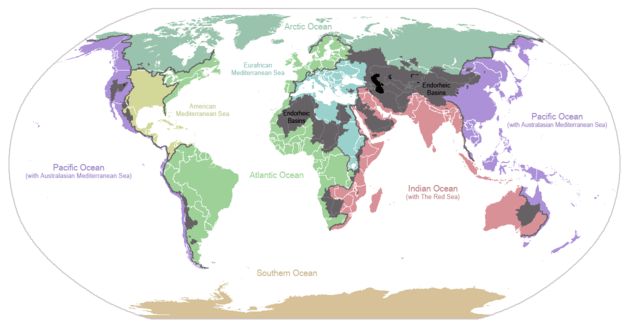
Almost 18% of our planet’s landforms drain not into the inter-connected ocean system but into such endorheic (“flowing within”) basins:

 [Note each ocean’s drainage area is color-coordinated, and endorheic basins are grey. “Why not sunshiny yellow?” I know, but still this map is just so cool.]

Don’t cry tears for the water.

River water escapes a basin eventually, either percolating into the soil or evaporating into the atmosphere. When you live like a water molecule, you have no “final destination.” You just keep moving through the hydrologic cycle.

Rather cry for the salt.

A river is not solely water. It’s also the load carried by that water – rocky, muddy bits of earth. These minerals remain behind when the water re-cycles, hence, like the ocean, basins are salty.

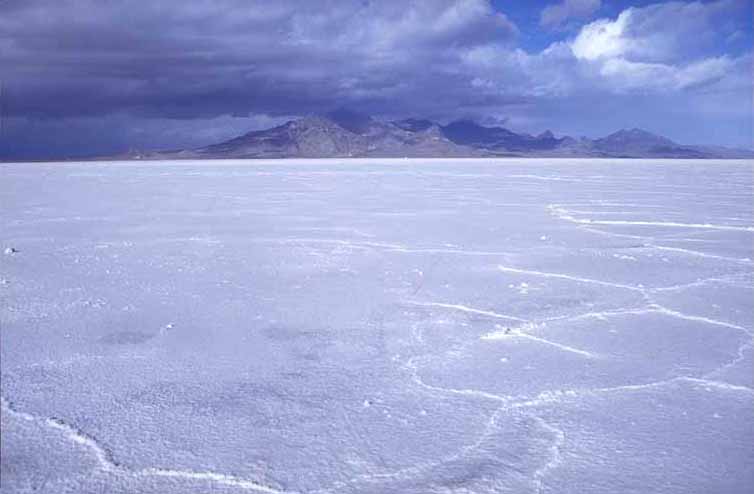
Photo from solarnavigator.net

It’s probably a duck.

Wait a second — if it looks like a sea (the lowest thing around), acts like a sea (receives rivers), AND tastes like a sea… then I say each basin, no matter how small, isolated, or even seasonally dry, IS a SEA.

“Inland sea” describes the noble sights pictured above more fittingly than the pedestrian terms basin, salt lake, or terminal lake (though not as prettily or accurately as the Spanish playa which evokes beach umbrellas, beach drinks embellished with umbrellas, and, of course, surfboards!). Worse yet are labels we assign intermittent/dry basins: Pan. Flat. Hole. Sink.

The grimness is somewhat understandable.

Humans can’t drink the brine of Devil’s Lake. And salting the earth WAS an ancient form of warfare for GOOD REASON: nothing grows in Death Valley.

Yet…

… we value salt. For years it’s served as currency, shaped trade routes, established cities, sparked wars, and rescued enhanced my cooking. Why?

Salt makes everything taste more like its essential self.

And authenticity is not only yummy but healing:

The cure for anything is salt water: sweat, tears, or the sea.” — Isak Dinesen

How astonishing that Jesus of Nazareth proclaimed — to mere humans — “you are the salt of the earth.” Us? WE make earthly life more.. earthy and lively?

How troubling that he went on to say…

“… but if that salt has lost its flavor, it ain’t got much in its favor.”

I’ve puzzled over this teaching since the very first time I saw Godspell. (I know the NRSV translates Matthew’s gospel as asking “How can its saltiness be restored?” but if Broadway writers can figure out how to rhyme it, I suspect the original guy could too.)

According to Mark’s gospel, Jesus provided his own answer:

“Have salt in yourselves.”

How can we possibly do THAT? The Mystery feels so much larger than us:

The river is within us, the sea is all about us.” — TS Eliot, Four Quartets

Perhaps our inland seas re-salt us.

Perhaps visiting those places inside — places where our world drains into frightening, gorgeous plains layered with crystallized burdens — releases our essential taste for savoring the earth, all its inhabitants, ourselves. One another. Delicious.

… only one thing among many.

Standing in a river, you feel good.

You sense the world differently.


Standing in a river, you swap vision with the hawk overhead and see you are only one thing in one river surrounded by one land… among many.

The ease and the kinship would be enough.

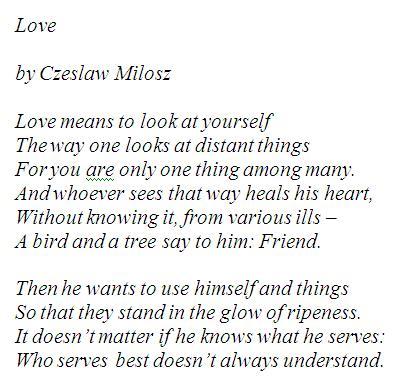
But it’s what comes next, like the second stanza of Milosz’s poem, which surprises. After standing in a river, you step into clear, creative service.

“Serving what purpose?” you used to cry.

It doesn’t matter to you now — you do what ripens things. You know how because you follow the glow, delighting always.

And if you lose sight, you go stand in the river.

… organic.

Does a river organize itself? How?

— Organization Guru formerly [and completely inaccurately] known as Dutch

Dear Organization Guru,

Sigh. Your combination of thoughtful spirituality and profound organization not only foils my attempt to justify bedlam with mysticism BUT ALSO steers me into the following blissful tizzy because:

• first of all, YES! I’ve actually witnessed a river “pulling itself together;”

• but more importantly, your note coaxes this accomplished justifier to consider…

What does “organize” even MEAN?

Well it turns out to mean – and I did NOT see this coming — to make into an organ.

An organ? The ancient Greeks assigned the word to weirdly disparate objects:

• an anatomical feature — picture an actual body organ (a polite one please) or

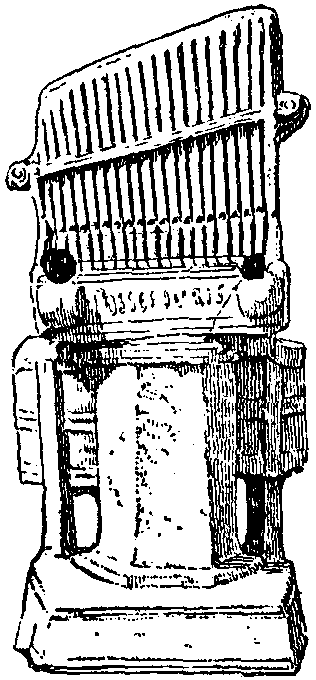
• an instrument – including an actual musical organ (obvious… but I never got it),

• a tool, or

any identifiable whole made from smaller parts and capable of harmonious, coordinated action akin to the homonym-ish cognate ergon which means… work.

Did you say Ergon?!!!!! (Cool Coincidence #1)

In the elegant world of physics, work is not the opposite of play.

They are the same thing — calculable with the same units as energy (which is also quantifiable and quite real).

And so I am mildly obsessed with physics and its sub-field of thermodynamics (the study of energy). Simply put:

  • there are times I’m desperate for energy (times known as “parenthood”);
  • there are times I question the concept of work, especially my life’s work (times scarily NOT limited to parenthood); and
  • play? Child, please.

Are you with me, Dear OG? Then get ready for a provocative connection:

Physicists measure energy AND play/work with a unit called… the erg!

Whaaat?

*I’m revisioning “organization” as erg-ization.*

Its direct link to energy makes organization appealing…

and explains your cosmic hum, Dear OG.

Furthermore… (Cool Coincidence #2)

My river education has two tributaries:

Hydrology = the study of water.

Hydraulics = a collection of laws (-ics) developed by the Greeks when they put water (hydr-) in pipes (aul) to make the hydraulus — their musical pipe organ!

Cue the woo-woo soundtrack, and make it ORGAN MUSIC:

*water + organ-izing = long joyful history*

But. (Potential Danger #1)

But a river is neither a set of pipes nor a useful tool meant to serve human whims, even whims as lofty as “Ode to Joy.”

It has been easy for us engineers to look at the world through our organ-colored glasses. We take river parts and re-organ-ize them into hopefully controllable conglomerations like dams, canals, levies. Hydrology’s helped us remember that which your question presumes:

*Our world’s true nature organizes itself.*

We’ve learned to look at the river, to let the river itself steer us:

We don’t have to tear apart natural organs and make tidy, artificial ones.

What about us humans? (Potential Danger #2)

Dear OG, you know by now that I believe our own true destinies, like a river (yay!), are “shaping” — that’s my grandmother’s expression for the status of most things. Her choice of words was wise because we DON”T have to wrestle our lives to the ground and force them into some careful design. The whole is there, emerging from the small stuff, like an organ.

But (again).

I have discovered that significant chunks of my outer AND inner life are less like natural systems and more like dis-organized synthetic instruments. When I clean, tune, and arrange my pipes, not to mention my closet or that drawer under the phone, I am energized in mysterious ways that allow the true me to pull itself together.

*A little erg-ization never made anyone into a cold, sterile tool.*

Indeed, it is a deep, almost knowable, sometimes chaotic, somehow organized integrity that enables the spiritual sense that is characteristic of wild rivers and your own life, Dear Organization Guru.

Thank you for your letter. I continue having fun with your real question: “how does a river organize itself?” Beautiful answers are shaping, organically:)

Betsy