Monthly Archives: March 2011

… Grand.

I asked about your pet immoderations. About two weeks ago, one of my favorite teachers tweeted:

I love going into seclusion; there’s nothing better in all of life.

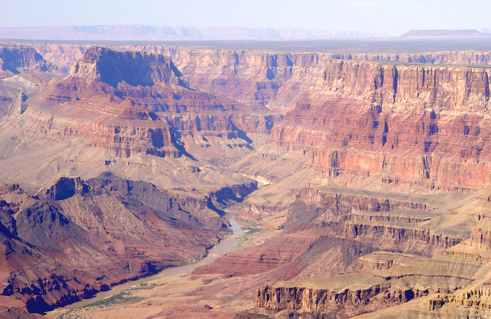
She reminds me of one my favorite rivers — THE poster child for what hydrologists term entrenchment.

In-a-trench

Entrenchment describes a river’s relationship to its surrounding landscape. It’s measured by how a river responds to increased flow. When life really starts to rock-and-roll, some rivers spread way out and inundate a huge wide floodplain. But the entrenched river has a high degree of “vertical containment.” She gets deeper and deeper without becoming much wider.

Is this okay?

Popular psychology sometimes worries about secluded individuals. So does hydrology. And yet two types of healthy natural rivers ARE quite thoroughly entrenched. One is the step-pool system I described earlier. The other is perfectly personified by my friend:

  • considerably entrenched down in some highly weathered material — she’s picturesque both at the close scale and from a panoramic viewpoint;
  • meandering through riffle/pool sequences – boaters love her intermittent respites almost as much as her thrilling rapids; and
  • flowing at low gradient in a relatively wide channel — unlike steep, straight, narrow waterfalls and cascades, my pal’s quite accessible.

People from all over the world invest great effort and money just to be in her presence:

Now that’s a meander.

I told you she was deep. 

So if one of the Seven Natural Wonders is a classic example of entrenchment…

… then why the bad rap?

1. It’s a question of foundation. Again.

An entrenched channel has a trapezoidal shape (unusual in natural streams though a favorite in engineering designs!) AND high stream banks. Physics-wise, this combination directs so much force onto the sidewalls that an entrenched river based on any material smaller than a Volkswagen WILL erode. Typical silt, sand, and gravel rivers simply can’t do well when disconnected from an expansive overflow area.

But the Colorado River (and my teacher) incised herself through layer after layer of solid rock. As we discussed last month, a river with a solid base will always thrive. The same holds true with humans.  Regardless of individual style, when you cultivate a clear, free mind, you’re carving a life in bedrock.

2. What’s left behind

Hydrologists put it like this: “entrenched rivers develop by abandoning their historic floodplains.” What’s left behind is no longer directly nourished by the river. That community (soil, plants, animals) converts to a different ecosystem. Plus now only a flood of huge magnitude makes the entrenched river over-top her banks — she can manage most action on her own. The adjacent flat is no longer indispensable. That’s a lot of change for folks to handle.

3. A reminder

Here’s how The Colorado herself responds to my mentor’s tweet.

Dear Teacher to Many,

Entrenchment reminds us of what trauma does – it makes a river downcut, often steeply and in a hyper-straight fashion. I imagine it’s similar with people. When the down-cutting ceases, the river’s back to her innate slope, albeit at a “deeper level,” and the river begins to broaden herself in order to once again create space for meandering.

This healing stage is a joyfully entrenched one.

No wonder we awe, frighten, and inspire.

Yours — C

And that’s one reason why the Colorado River and Martha Beck are my heroes.

… rich

Dear Betsy — So maybe one of your other rivers could answer my question: at what point am I spreading myself too thin and how do I ensure quality over quantity! – The Strong Gold Heart River


Dear Strong Gold Heart,

What a valuable question. THE single most common river problem occurs when some event widens a stream’s channel, requiring the usual flow to cover more area than usual.  The broadening stream becomes shallower — literally “spread thin!”

Stretching out always forces a river to loose speed — a beautiful thing when it happens on the stream’s floodplain. But when it happens in the main channel, there’s trouble.

A stream’s power (its energy during any given period of time) is directly proportional to velocity. As it slows, the stream can’t do its life’s work — carrying clay, boulders, or whatever sediment is at hand. A human life’s work more likely includes preparing dinner, a joke, an account, a romantic moment, a book, yet another book… how do you know when you’re out of control??

There are two sure-fire ways to recognize a spread-thin river.

1st Red Flag: Aggrading

The stream drops its load. Right there in the middle of its channel.

2nd Red Flag: Degrading

Ironically, after the water lightens itself, it has EXCESS energy:

  • because it’s hungry (so the stream eats its own edges ragged); and
  • because the sediment wedge creates a drop off the backside (making the water more steep and powerful at that spot).
    • This falling water digs pools where there should be shallower riffles, and
    • as it erodes the back of the sediment wedge, the falling water slices its way upstream. Such “head cuts” create whitewater-like riffles even on bends where there should be calm pools.

Here’s my own Big Goose Creek. You can see the sediment wedge turning into a center island, the raw stream bank on the right, and, if you look closely, some misplaced ruffled water characteristic of a head cut:

So in answer to the first part of your question, my friend: If your edges fray, if you develop stagnant piles of stuff where there should be easy flow, or if you’re tackling rapids where there should be serene water, then you are spread too thin.

How to ensure this doesn’t happen? I am preparing some specific stream-type energy management ideas. Meanwhile, I LOVE how human energy is portrayed in this guided meditation as a balanced braid of three “currencies” — physical, financial, and time.

We call someone with robust physical energy healthy, someone with abundant financial energy wealthy… and maybe Ben Franklin alludes to wholesome time energy in the final third of his phrase “Healthy, Wealthy, and Wise.” Because there’s really no synonym for time.  Nor a name for someone who tends the energy of time — unless, as with you dear river, it’s the one with heart.  Thank you for your letter, your precious support, and your priceless example to those of us who follow your adventures with awe.

“The only question is: Does this path have a heart?  If it does, then it is a good path. If it doesn’t, then it is of no use.” – Carlos Castanada

… live aloha!

I’m back from Hawaii but remember — I went to WORK!  My goal was to find wild rivers on whom I could test our hypothesis:

The most playful play IS rest. AND work. So ALL of daily life is… vacation.

Here are my field notes:

Fail?

My vacation reading list is an identically blank page; I spent zero hours on a computer; and since I was travelling with my two stoic male types, there wasn’t even much conversation. The week was weirdly wordless.

Weird because I like words. A lot. Reading them, writing them, scrolling through them in texts and tweets and posts. Talking them! Listening to them!!

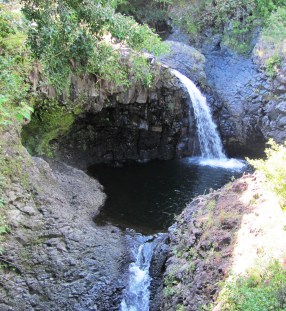
Instead I walked. Snorkeled. Slept. Splashed in waves. Slept. Hiked to waterfalls. STOOD in waterfalls. Slept. And, most wonder-fully of all, SURFED ( pix here!).

So, my week ended up mostly play and sleep. BUT physics-wise, you most certainly have noticed I ALSO performed work the whole time — that is, I was always moving something somewhere. For example:

• Paddling, paddling, paddling my board back out to the lineup. Okay there wasn’t really much of a lineup other than my son and Ricardo, our 49-year old Peruvian surf instructor (we were lucky The Sisters weren’t there since Ricardo had a whole Antonio-Banderas-as-ripped-surfer thing going on), but I must practice surfer jargon. The day said son graduates from high school, I turn surf bum.

• Expanding my lungs to inhale, then compressing them to exhale – over and over, loudly, through my mouth and into a tight little tube, while keeping my entire face submerged even though I’m scared of water. (Yes you read that right. Ironical? Or just fodder for a “feel the fear and do it anyway” post?)

• Casting my eyes from three whales blowing on the left side of the horizon to two breaching on the right while otherwise holding completely still in a lounge chair.

• Stretching smile muscles ’til my face hurt.

• Expanding my lungs to snore in, then compressing them to snore out – over and over, for 9 ½ hours each night.

While it doesn’t directly address our happy hypothesis, my trip proves this corollary:

A vacation is work — BECAUSE of the play — and therefore, deep rest.

But what about Hawaiian rivers — would my [non-existent though well-intended] field notes on their DAILY WORK-A-DAY LIFE have proven our original hypothesis? Take a look and let me know what you think:

Aloha, my dear friends.