
Remember when our Dear Organizational Guru asked:
“How does a river organize itself?”
The river doesn’t have a brain, a laptop or any one central intelligence. And yet it ALWAYS creates something supremely gorgeous and functional.
The river’s secret…
… is what mathematicians and scientists call self-organization. Rather than sprouting from one primary unit, a river’s patterns and structures are created by local interactions of components in a way that’s:
- parallel — all of the local interactions occur at the same time — and
- distributed — no one element coordinates the process.
Sweet Example: Point-Bars and Pools
The structure —
Stream meanders develop sediment bars inside curves and pools with cut banks on the outside. You can see how this pattern develops throughout a river system :
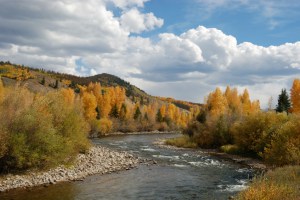
Stream Type C — Blue River, Colorado (stock photo)
How it works —
The point bar is underwater during peak flow, at which time it shuttles sediment like a conveyor belt. As high water recedes, the river drops most of its sediment load, and the bar sits exposed… until the next spring flow covers the bar and mobilizes the sediment once more. This cycle means plants can’t really root on active point bars.
The battle against nature —
It sounds silly to fight a river’s self-organization, but pretend YOU own a lovely little piece of paradise. Imagine that one side of your stream bank keeps reverting to bare ground and the other side to a vertical drop-off into a deep pool. You might try to “stabilize” and “beautify” the point bar with transplanted willows like someone did with this well-intended but misguided restoration effort:
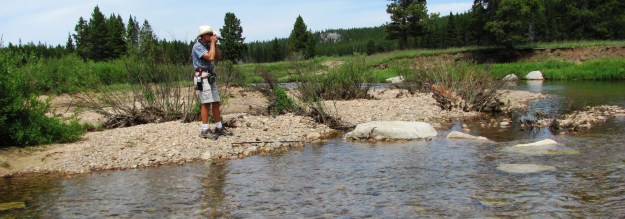
See how the creek scoured around the willow transplants? Interference always requires exhausting maintenance because the creek continues its natural self-organizing behavior.
But even worse, if the interferer perserveres and “succeeds,” the artificially imposed organization creates a nightmarish domino effect.
For example, if you armor a point bar with vegetation, then you prevent the river from moving sediment across the bar. Instead, the river actually builds the bar higher which narrows the river’s width and down-cuts the river bed — destabilizing the river’s profile far upstream and down.
A solution that will L.A.S.T. —
1. Look.
See intrinsic patterns and structure (aka reality) rather than imagining how the world “should” look.
2. Acknowledge .
Say to yourself, “Wow! This thing must be self-organizing around natural principles!”
3. Surrender.
Decide you like the natural way — love yourself some bare-naked point-bar!
4. Take a page from nature’s book.
If there’s an instability you really DO want to fix, like the raw bank on the other side of your imaginary creek (and the creek pictured above), then look for OTHER natural principles to help you out. For example, the would-be-restorers might have noticed that banks erode more slowly to the degree they are:
- separated from the low flow channel by a low “bench,”
- well vegetated, and
- at a less steep slope.
In the above photo, you can see they DID build and sod a low bench next to the eroding bank on the opposite bank. Yay! It would have been even better if they had sloped the vertical bank and sown some native grasses on the incline, but it might still heal over time (I’ll take some photos this summer and let you know).
Sour Example: Shoes, Pens, and Hair-ties
The structure —
Shoes clutter the corner of my home’s entry; pens litter the coffee table; my daughter’s hair-ties tangle into a nest on her bedside table.
How it works —
Residents — apparently raised in barns, by wolves – drop stuff WHERE THEY STAND WHEN FINISHED (WTSWF).
The battle —
I relentlessly nag advocate for a more civilized principle: stow items at their POU (Point of Use). Yes my ‘advocacy” exhausts us all and has a nightmarish domino effect.
LASTT’ing success —
1. Look.
Okay…I see PILES OF STUFF. Hmm. But they ARE sorted by type of stuff! Interesting.
2. Acknowledge.
The house IS self-organizing in a parallel and distributed pattern resulting from the local interaction of elements according to a natural principle (WTSWF). Or should I say WTF.
3. Surrender.
Fine.
BUT I don’t like the messy vibe! And if Mama Wolf ain’t happy… it needs fixing.
4. Take a page from nature.
I notice that sometimes barn-raised wolves will put things in a container if the container is both WTSWF and pre-seeded with like objects. So I put a handsome, sturdy basket in the hallway and salt it with some sandals; find a cute pen canister for the coffee table; and throw some old chipped, cup-less saucer on my daughter’s nightstand because that place is hopeless anyway.
5. Take as many pages as you need!
Since stuff is not at its designated POU when the baby wolves want it (i.e, in their closet, desk, or bathroom), I could apply some other natural principles like my favorite: “if you want to act like a barn animal then you can run around like a chicken with its head cut off finding your stuff in the morning”
But sometimes the natural consequences principle feels too harsh considering that IF they were raised in a barn by wolves AND I’m their mother, then… what does that make me? At fault, of course! In the midst of maternal guilt fits, I might pity the hapless lambs, invest in another set of containers to place at the POU, and swap them out when the WTSWF cups runneth over. But that’s entirely dependent on my whims — one of the perks of being the alpha wolf! It’s always your own call, my fellow river wolves. Just don’t fight nature, especially your own. XXX



 Like a River...