
Does a river organize itself? How?
— Organization Guru formerly [and completely inaccurately] known as Dutch
Dear Organization Guru,
Sigh. Your combination of thoughtful spirituality and profound organization not only foils my attempt to justify bedlam with mysticism BUT ALSO steers me into the following blissful tizzy because:
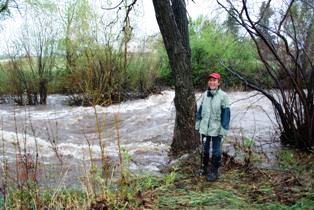
• first of all, YES! I’ve actually witnessed a river “pulling itself together;”
• but more importantly, your note coaxes this accomplished justifier to consider…
What does “organize” even MEAN?
Well it turns out to mean – and I did NOT see this coming — to make into an organ.
An organ? The ancient Greeks assigned the word to weirdly disparate objects:
• an anatomical feature — picture an actual body organ (a polite one please) or
• an instrument – including an actual musical organ (obvious… but I never got it),
• a tool, or
• any identifiable whole made from smaller parts and capable of harmonious, coordinated action akin to the homonym-ish cognate ergon which means… work.
Did you say Ergon?!!!!! (Cool Coincidence #1)
In the elegant world of physics, work is not the opposite of play.
They are the same thing — calculable with the same units as energy (which is also quantifiable and quite real).
And so I am mildly obsessed with physics and its sub-field of thermodynamics (the study of energy). Simply put:
- there are times I’m desperate for energy (times known as “parenthood”);
- there are times I question the concept of work, especially my life’s work (times scarily NOT limited to parenthood); and
- play? Child, please.
Are you with me, Dear OG? Then get ready for a provocative connection:
Physicists measure energy AND play/work with a unit called… the erg!
Whaaat?
*I’m revisioning “organization” as erg-ization.*
Its direct link to energy makes organization appealing…
and explains your cosmic hum, Dear OG.
Furthermore… (Cool Coincidence #2)
My river education has two tributaries:
Hydrology = the study of water.
Hydraulics = a collection of laws (-ics) developed by the Greeks when they put water (hydr-) in pipes (aul) to make the hydraulus — their musical pipe organ!
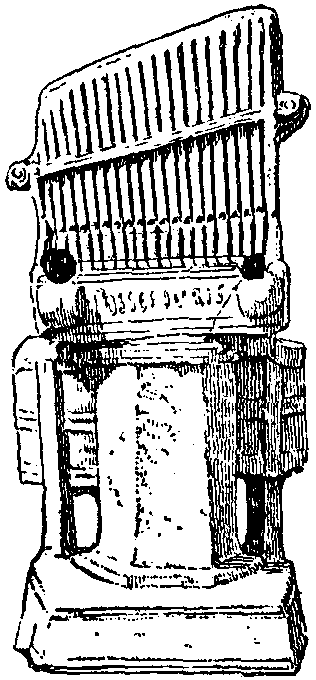
Cue the woo-woo soundtrack, and make it ORGAN MUSIC:
*water + organ-izing = long joyful history*
But. (Potential Danger #1)
But a river is neither a set of pipes nor a useful tool meant to serve human whims, even whims as lofty as “Ode to Joy.”
It has been easy for us engineers to look at the world through our organ-colored glasses. We take river parts and re-organ-ize them into hopefully controllable conglomerations like dams, canals, levies. Hydrology’s helped us remember that which your question presumes:
*Our world’s true nature organizes itself.*
We’ve learned to look at the river, to let the river itself steer us:
We don’t have to tear apart natural organs and make tidy, artificial ones.
What about us humans? (Potential Danger #2)
Dear OG, you know by now that I believe our own true destinies, like a river (yay!), are “shaping” — that’s my grandmother’s expression for the status of most things. Her choice of words was wise because we DON”T have to wrestle our lives to the ground and force them into some careful design. The whole is there, emerging from the small stuff, like an organ.
But (again).
I have discovered that significant chunks of my outer AND inner life are less like natural systems and more like dis-organized synthetic instruments. When I clean, tune, and arrange my pipes, not to mention my closet or that drawer under the phone, I am energized in mysterious ways that allow the true me to pull itself together.
*A little erg-ization never made anyone into a cold, sterile tool.*
Indeed, it is a deep, almost knowable, sometimes chaotic, somehow organized integrity that enables the spiritual sense that is characteristic of wild rivers and your own life, Dear Organization Guru.
Thank you for your letter. I continue having fun with your real question: “how does a river organize itself?” Beautiful answers are shaping, organically:)
Betsy
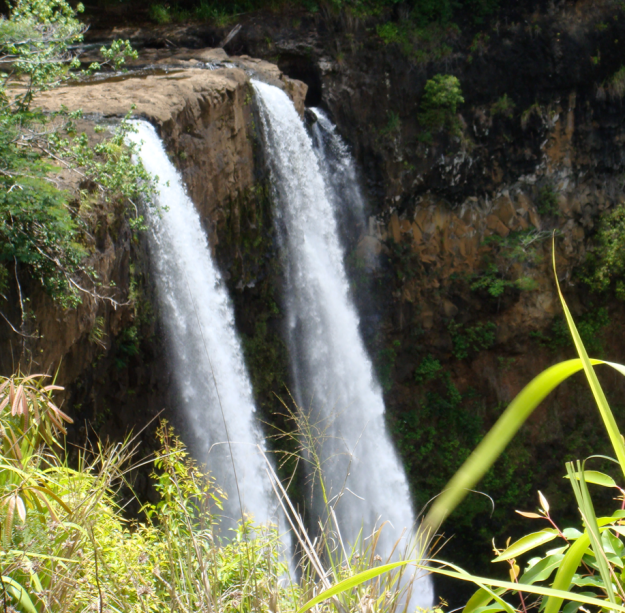
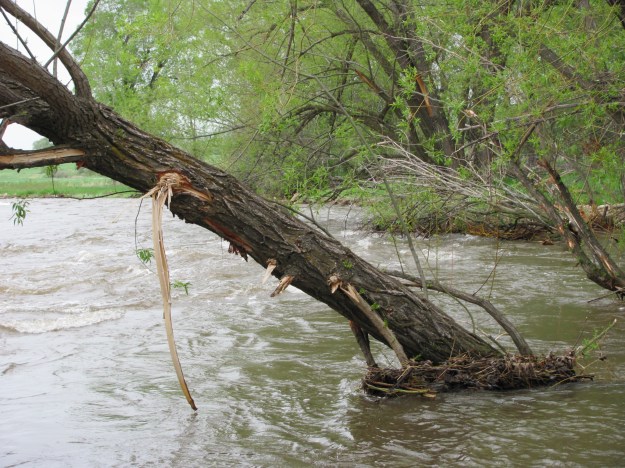
 At one extreme, -10 represents your human equivalent of feeling like a gutted river with raw banks, piles of goop in the middle of the channel, abrupt drop-offs, and flotsam-laden scour holes.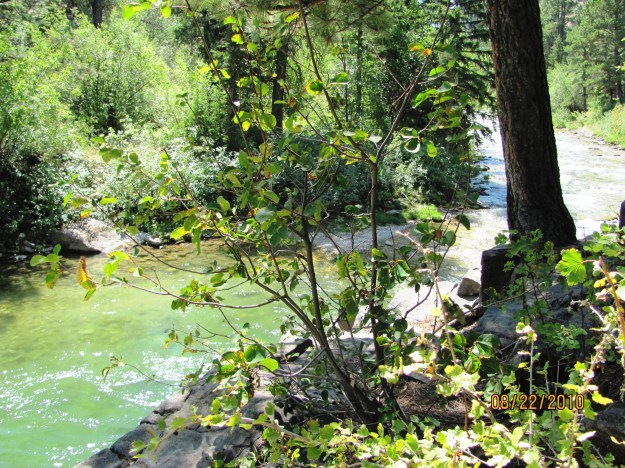
 Without any occasion, LG had given me a present: The Second Half of Life by
 Like a River...